
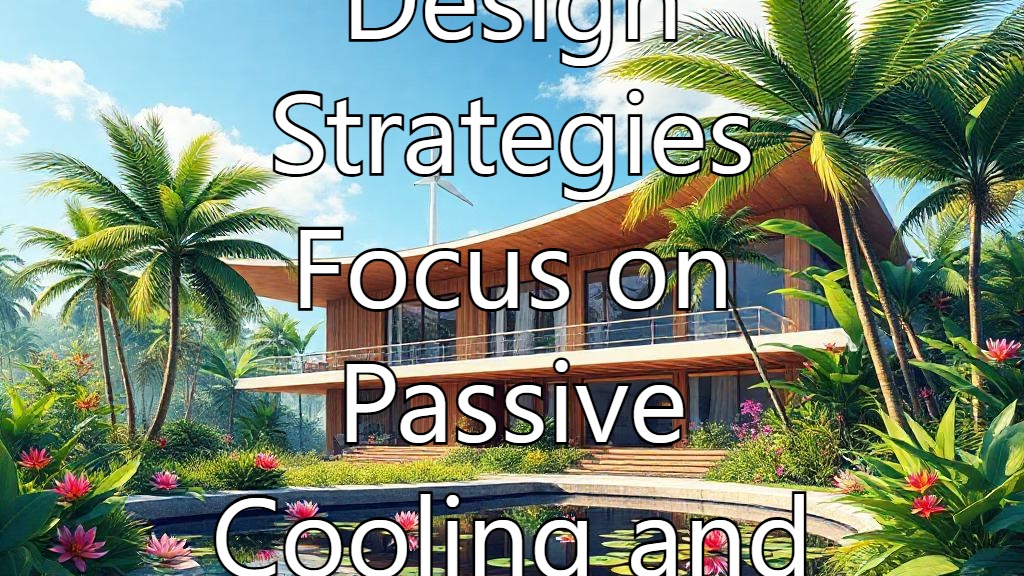
The world is grappling with the challenges of climate change, and the built environment is often likened to a living organism, with buildings acting as the lungs that breathe life into urban ecosystems.
In tropical climates, where the sun beats down relentlessly, this analogy takes on a newfound sense of urgency, as structures must be designed not only to withstand the heat but also to mitigate its effects.
Can buildings be created that thrive in these conditions, much like a lotus flower blooms in the warmest of waters, its beauty and resilience a testament to the power of adaptation?
By focusing on passive cooling and renewable energy systems, architects and designers can craft tropical climate building design strategies that minimise environmental impact while maximising occupant comfort.
Tropical Passive Design Strategies: Optimising Building Design for Passive Cooling and Energy Efficiency
In tropical climates, buildings can be designed to mitigate the harsh effects of heat and humidity, reducing the need for air conditioning and promoting energy efficiency.
By incorporating natural ventilation, shading, and insulation, architects can create structures that not only conserve energy but also provide a comfortable living space.
Building orientation and layout can significantly impact energy consumption, with strategic placement of windows and doors maximising natural light and ventilation.
Green roofs and walls can provide additional insulation, reducing heat gain and energy losses.
Implementing solar shading devices can minimise direct sunlight, decreasing the need for air conditioning and promoting a cooler indoor environment.
Passive Design Strategies for Reducing Reliance on Mechanical Systems in Tropical Regions
Passive design strategies can help reduce reliance on mechanical systems, leveraging natural elements like shade, wind, and thermal mass to regulate indoor temperatures.
By incorporating these techniques into building design, a more comfortable and sustainable living space can be created.
This approach not only reduces energy consumption but also promotes a healthier environment.
Maximising Natural Ventilation and Shading in Tropical Climate Building Construction
The Solaris building in Singapore is a prime example of incorporating natural ventilation and shading techniques, featuring a unique façade design that reduces heat gain and maximizes airflow, resulting in a 30% reduction in energy consumption.
This innovative approach not only minimises the building’s carbon footprint but also creates a more comfortable indoor environment for occupants.
The key to maximising natural ventilation lies in careful building orientation and design, taking into account the prevailing wind patterns, wind direction, and sun paths to minimise heat gain and maximise airflow, since natural ventilation uses wind and buoyancy for airflow. Wind-driven ventilation creates airflow through well-placed door and window openings on opposite sides of a space, improving cross ventilation and overall wind flow. Buoyancy-driven ventilation relies on stack ventilation, where warm air rises and exits while cool air and fresh air are drawn in. High ceilings with roof vents help strengthen this effect, remove warm air more effectively, and reduce reliance on mechanical ventilation and mechanical cooling systems.
Incorporating Renewable Energy Systems into Tropical Climate Building Design
Incorporating renewable energy systems into building design is crucial in tropical climates, where the sun beats down relentlessly, and the air is thick with humidity.
Buildings in these regions can be designed to harness the power of the sun, wind, and rain, reducing their reliance on non-renewable energy sources and mitigating the urban heat island effect.
Large windows and solar panels can be strategically placed to maximise natural light and heat, while green roofs and walls can provide insulation and reduce energy consumption.
Understanding Microclimates for Effective Passive Design Strategy Deployment
To deploy a passive design strategy effectively, it’s crucial to understand the local climate and local climate conditions, including the microclimates present in a specific area.
These conditions can vary greatly from one location to another, even within a small radius, and are influenced by factors such as terrain, vegetation, and built structures.
Understanding solar radiation, intense solar radiation, and the surrounding environment helps tailor passive systems to the site.
By studying microclimates, architects and designers can create buildings that work in harmony with their surroundings, reducing the need for mechanical heating and cooling systems. This early design process can then be tested with energy and environment modeling and environment modeling to improve heat regulation in a passive building.
Designing Buildings that Utilise Solar Shading and Natural Ventilation Techniques
Incorporating eco-friendly design elements can greatly reduce a building’s carbon footprint.
Implementing green roofs to provide insulation and reduce energy consumption can be effective.
Utilising solar shades to reduce direct sunlight exposure and excessive heat gain can also be beneficial.
Deep verandahs are a practical shading feature for tropical buildings, helping protect interiors from direct sunlight exposure.
Vertical shading devices work especially well on east and west-facing exterior walls.
Horizontal shading devices such as overhangs are effective on north and south-facing walls.
Applying passive design techniques through the building form and well-placed openings can improve airflow, lower solar heat gain, reduce reliance on artificial lighting, and limit the size of the cooling system.
Strategies for Mitigating Climate Change Through Sustainable Tropical Building Design
Sustainable tropical building design is crucial.
A well-designed building can reduce its carbon footprint, significantly impacting the environment.
Incorporating green roofs, solar panels, and recyclable materials can be effective strategies.
Tropical regions like Singapore are leading the way in sustainable building design, with initiatives like the Singapore Green Building Masterplan, which aims to reduce energy consumption and greenhouse gas emissions.
Innovative Materials and Technologies for Energy-Efficient Tropical Climate Buildings
Modern materials and technologies, along with appropriate building materials, such as green roofs and solar windows, can significantly reduce energy consumption, limit heat absorption, improve indoor air quality, and enhance comfort within the building interior in tropical climates. Double skin roofs reduce heat transfer into buildings and improve indoor comfort in tropical buildings. Suitable moisture resistant building materials and moisture resistant materials also help prevent mold and structural damage in humid conditions.
The building sector accounts for nearly 40% of global energy consumption and is responsible for about one-third of global greenhouse gas emissions.
Creating Zero-Carbon Buildings in Tropical Climates through Total Decarbonization Efforts
Creating zero-carbon buildings in tropical climates has become a pressing concern, requiring a multifaceted approach that incorporates key passive design strategies and other passive strategies as part of decarbonization in warm tropical climates, alongside innovative design methods, cutting-edge technologies, and a deep understanding of the local environment.
The process of decarbonization involves a thorough analysis of the building’s lifecycle, from material selection to operational energy consumption, in order to identify areas of improvement and implement effective reduction strategies.
This is also where the volumetric cooling effect can be strengthened when building form is considered early in the design process.
Features such as a ceiling window open for daylight and ventilation can admit solar light while supporting passive cooling when carefully controlled.
The integration of renewable energy sources, such as solar and wind power, can significantly reduce a building’s reliance on fossil fuels and lower its carbon footprint.
Total decarbonization efforts require a fundamental transformation of the built environment, prioritising sustainability, energy efficiency, and environmental stewardship.
The tropical city of tomorrow begins to take shape, a vibrant tapestry of form and function, where human ingenuity and nature’s splendour blend in perfect harmony.
The buildings of the future will be a testament to the ability to adapt, to innovate, and to create a better world for generations to come.