

Key Takeaways
AI can make geotechnical back-analysis faster and more consistent, but it does not replace the Professional Engineer responsible for the design and submission. The strongest ERSS workflows connect trustworthy monitoring data, calibrated numerical models, transparent assumptions, and clear authority evidence.
- Back-analysis helps reveal how soil, groundwater, support systems, and adjacent structures behave in reality.
- Data quality and consistent records matter more than model sophistication alone.
- Machine learning is most useful when paired with engineering models and domain judgment.
- Validation, uncertainty analysis, and independent monitoring checks are essential before relying on predictions.
- ERSS submissions must explain methods, limitations, trigger levels, and decisions in an auditable form.
Understand the role of back-analysis in ERSS design
ERSS design begins with an interpretation of ground conditions, but construction provides an opportunity to test that interpretation. Back-analysis compares predicted behavior with observed movement, pore pressure, settlement, and structural response. For Innovation Directors, Computational Engineers, and Professional Engineers, this creates a disciplined way to improve decisions without treating a model as a substitute for engineering responsibility.
What geotechnical back-analysis reveals about actual ground behavior
A site investigation describes soil stratification, groundwater, and material properties at selected locations. Actual construction behavior may reveal something different: a softer layer than expected, a delayed pore-pressure response, or stiffness that changes with excavation stage. Back-analysis uses monitoring and construction history to identify which assumptions best explain what the site has done.
The result is not simply a better-fitting number. It is a clearer understanding of mechanisms such as wall deflection, basal heave, consolidation, seepage, and stress redistribution. That understanding can inform revised predictions and more appropriate construction controls.
How observational data supports Earth Retaining or Stabilising Structures decisions
Earth Retaining or Stabilising Structures must control lateral ground movement while excavation proceeds beside buildings, utilities, roads, and other infrastructure. Observations from inclinometers, piezometers, settlement points, crack gauges, and surveys can show whether the system is performing within its intended envelope. They also provide evidence for deciding whether excavation can proceed, whether a support stage needs review, or whether a contingency response is required.
In Singapore, ERSS verification follows the limit state philosophy in SS EN 1997-1, with attention to ultimate and serviceability limit states. Back-analysis does not remove those checks. Instead, it helps relate design assumptions to site behavior and supports a more informed assessment of deformation and stability.
Where conventional back-analysis approaches become slow or subjective
Traditional back-analysis often depends on manually cleaning readings, selecting a limited set of observations, adjusting parameters, and repeating numerical runs. That work can be technically sound, yet difficult to reproduce when files are scattered across spreadsheets, reports, and construction records. Different analysts may also make different judgments about which readings are representative or which parameters should be changed first.
The difficulty increases when monitoring arrives in stages. A model calibrated during early excavation may need to be reconsidered after strutting, anchoring, dewatering, or a change in construction sequence. Without a controlled workflow, useful observations can become a late-stage explanation rather than an active part of design management.
The value of AI and machine learning for Innovation Directors and Computational Engineers
AI and machine learning can help organize observations, identify relationships, rank influential parameters, and reduce the number of expensive numerical simulations. Their value is greatest when they support a defined engineering question, such as estimating a parameter range or screening a construction-stage response. The engineering innovation podcast is a useful broader reminder that computational tools should be assessed by practical engineering value rather than novelty.
For Computational Engineers, this means building repeatable pipelines around established soil mechanics. For Innovation Directors, it means setting governance, validation, and adoption criteria before scaling a pilot. The aim is not automation for its own sake, but a traceable connection between evidence, model behavior, and an engineering decision.
Build a reliable data foundation for AI-enabled analysis
An AI-enabled back-analysis workflow is only as reliable as the information it receives. Site investigation data, instrumentation, drawings, construction records, and design revisions must be brought into a consistent structure before analysis begins. This foundation also makes later review easier for Professional Engineers and authorities.
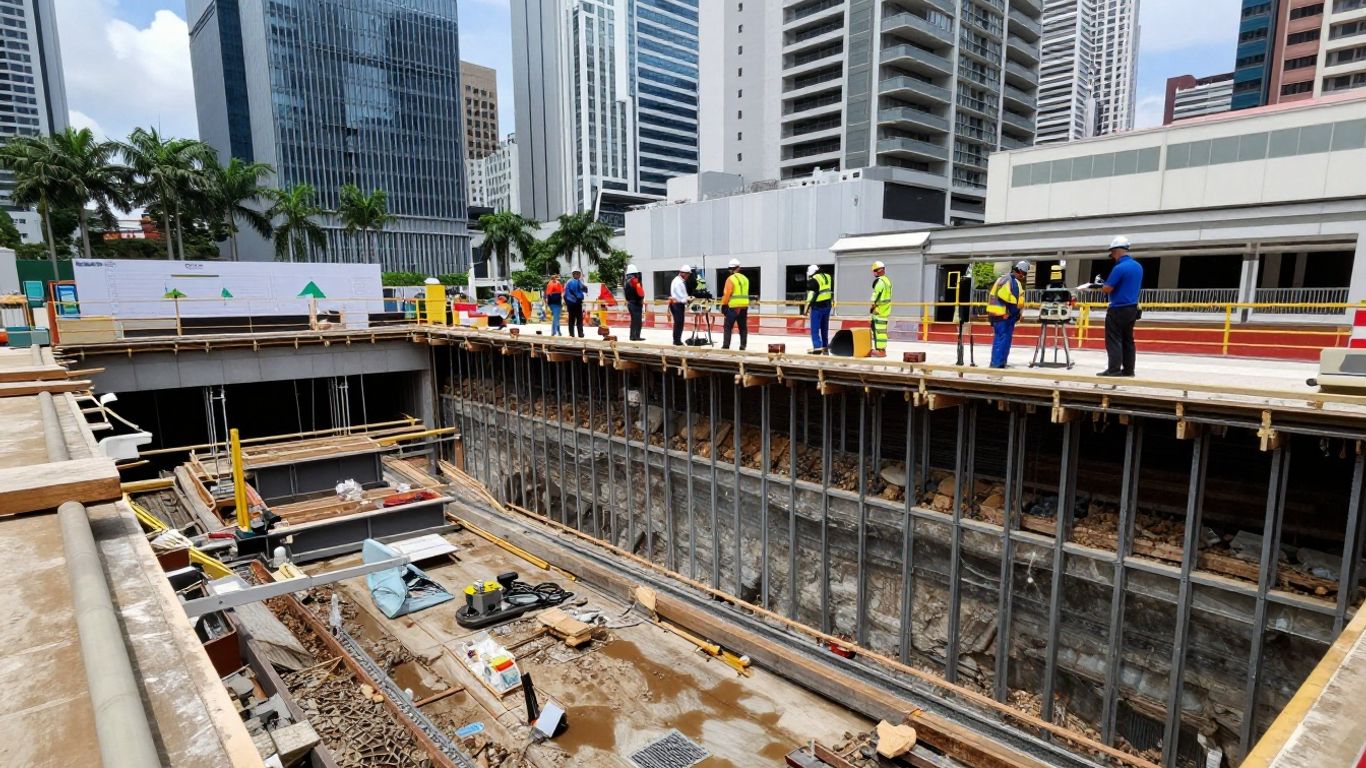
Combining site investigation, instrumentation, and construction records
No single data source explains an excavation completely. Boreholes and laboratory testing describe materials; instrumentation records response; daily reports and method statements explain what was actually built. The analysis should preserve the relationship among these sources, including dates, locations, installation details, excavation levels, support installation, pumping, rainfall, and pauses in work.
A useful data register records source, owner, coordinate system, units, collection method, and confidence level. It should also distinguish planned activities from completed activities. That distinction is essential when a model is being calibrated against construction that diverged from the original sequence.
Structuring soil, groundwater, geometry, and loading data
Data should be arranged so that every parameter has a clear physical meaning and spatial or temporal context. Soil layers require depth intervals and material descriptions; groundwater requires measurement location and datum; geometry requires revision status; loading requires magnitude, location, and timing. Consistent naming prevents a model from quietly treating similar labels as different variables.
A practical structure separates raw records from processed inputs. Raw readings remain unchanged, while transformations, assumptions, and exclusions are recorded in a processing layer. This preserves traceability when a reviewer asks why a value used in the analysis differs from the original field record.
Preparing time-series data from inclinometers, piezometers, and survey monitoring
Time-series preparation starts with synchronized timestamps and stable reference points. Readings should be connected to construction stages so that a movement trend can be interpreted alongside excavation depth, strut installation, anchor stressing, or dewatering. Rates of change can be as informative as absolute displacement, particularly when a previously stable trend accelerates.
The workflow should retain both the measured series and any derived series, such as cumulative displacement, incremental movement, or normalized pore pressure. That makes it possible to distinguish a genuine site response from an artifact introduced during preprocessing.
Managing missing values, inconsistent readings, and measurement uncertainty
Missing or inconsistent readings are normal in field monitoring. A sensor may be inaccessible, a survey prism may move, or a datum may be reset. Replacing every gap with a convenient estimate can create a false sense of continuity, so the method used for imputation, exclusion, or interpolation must be recorded and reviewed.
Before a model is trained or calibrated, the team should check for:
- Sensor drift, reset events, and unusual step changes.
- Unit, datum, coordinate, and timestamp inconsistencies.
- Readings affected by construction access or temporary obstruction.
- Uncertainty ranges associated with instruments and laboratory results.
These checks make the model less likely to learn data-collection behavior instead of ground behavior. They also give the submission team a defensible explanation for why confidence in one observation differs from confidence in another.
Protecting data quality through BIM and Common Data Environment workflows
BIM and a Common Data Environment can provide a controlled setting for geometry, revisions, monitoring records, and approval status. The benefit is not the file format alone. It is the ability to connect a model input to an issued drawing, a construction stage, and a responsible reviewer.
The broader field of computational engineering practice similarly depends on combining mathematics, physics, computer science, and disciplined model use. In an ERSS project, naming conventions, permissions, revision control, and review gates should be established before automated analysis is introduced.
Select AI and machine learning methods for geotechnical back-analysis
Method selection should follow the engineering question and the available evidence. A small, carefully curated dataset may favor a transparent regression model, while a large monitoring archive may support more complex learning methods. Every method still needs physically sensible inputs, meaningful validation, and a clear explanation of what it can and cannot predict.
Using supervised learning to estimate soil and structural parameters
Supervised learning can map observed responses to known or calibrated parameters when suitable training examples exist. Potential applications include estimating ranges for stiffness, permeability, or interface behavior from site and monitoring features. The output should normally be treated as a parameter estimate or screening aid, not as an automatic design value.
Training data must represent the type of soil, geometry, support system, and construction sequence under consideration. If the examples come from unrelated sites, the apparent accuracy may not survive transfer to the project at hand.
Applying unsupervised learning to identify ground-response patterns
Unsupervised methods can group monitoring records according to movement shape, pore-pressure response, or stage-related behavior without requiring predefined labels. This can help identify sensors that behave differently from their neighbors or excavation stages that warrant closer review.
Clusters are not explanations by themselves. A group of readings may reflect geology, instrument location, a construction event, or a recording problem. The engineer must return to drawings, field records, and physical mechanisms before assigning meaning.
Using surrogate models to accelerate numerical simulations
Numerical analyses can become expensive when many combinations of soil parameters, groundwater conditions, support stiffness, and construction sequences must be tested. A surrogate model approximates selected numerical outputs after being trained on carefully designed simulation runs. It can then screen scenarios more quickly than rerunning the full model each time.
The surrogate is valid only within the range and structure of its training cases. It should be checked against additional numerical runs, especially near decision thresholds or where the response changes sharply.
Combining machine learning with finite element and finite difference methods
Machine learning is most useful when it complements, rather than obscures, finite element or finite difference analysis. A calibrated PLAXIS Suite workflow can represent geometry, stratigraphy, groundwater, constitutive behavior, and construction staging, while a learning model may help prioritize parameters or approximate repeated scenario runs.
The numerical model remains the place where boundary conditions, material behavior, support installation, and staged excavation are explicitly represented. The learning layer should be linked to that model through documented inputs and outputs, with clear controls against physically impossible predictions.
Choosing interpretable models for engineering and regulatory review
Interpretability matters because an ERSS submission must communicate assumptions and reasoning to people who may not have built the model. Feature importance, partial-dependence checks, sensitivity plots, and physically meaningful parameter relationships can help, but they do not replace a technical narrative.
A simpler model with a known error range may be preferable to a more complex model that cannot explain why a prediction changed. Reviewability is part of technical fitness, particularly where authority comments, design checks, and professional endorsement are involved.
Develop an integrated back-analysis workflow
An integrated workflow turns isolated experiments into a controlled engineering process. It begins with a decision that the analysis must support, then connects data preparation, numerical modeling, learning methods, validation, review, and documentation. This sequence keeps the technology subordinate to the design purpose.
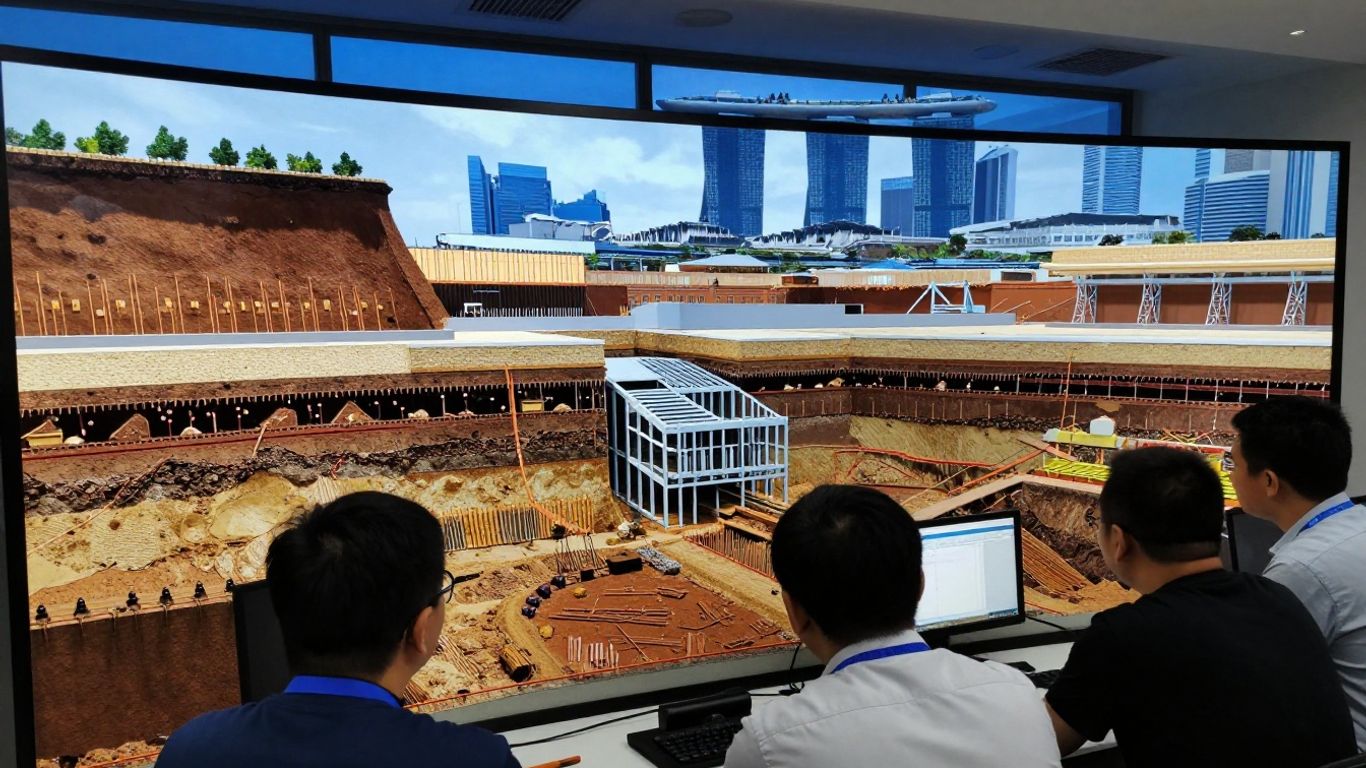
Defining objectives, performance criteria, and decision thresholds
The team should state whether the back-analysis is intended to refine deformation estimates, assess groundwater response, investigate an unexpected movement, or support a construction-stage decision. Performance criteria should be measurable and tied to the ERSS design basis, monitoring plan, and adjacent-asset risk.
Thresholds also need defined actions. A trigger without an assigned response is merely a number in a dashboard. The decision register should identify who reviews an exceedance, what additional information is required, and when work must pause or be modified.
Calibrating constitutive parameters against observed site behavior
Calibration should change parameters for a reason that can be explained through soil behavior. For example, stiffness, strength, permeability, or creep parameters may be examined against deformation and pore-pressure trends, provided the geometry, sequence, and boundary conditions have first been checked. Calibration should not become a search for the one parameter set that fits every noisy reading.
Constitutive choices may include Mohr-Coulomb, Hardening Soil, or Soft Soil Creep models where their assumptions suit the material and analysis objective. Laboratory results, field evidence, and engineering judgment should be considered together rather than allowing an algorithm to override a credible test result.
Running sensitivity and uncertainty analyses
A calibrated result is incomplete without understanding what could change it. Sensitivity analysis varies influential inputs and records their effect on movement, stability, groundwater, or structural response. Uncertainty analysis then communicates the range of plausible outcomes instead of presenting a single value with unjustified precision.
A useful scenario matrix can keep this work organized:
| Scenario | Main variable | Engineering question | Evidence to retain |
|---|---|---|---|
| Baseline | Calibrated soil parameters | Does the model reproduce observed trends? | Inputs and residuals |
| Low stiffness | Deformation parameters | How sensitive is movement prediction? | Displacement envelopes |
| High groundwater | Hydraulic conditions | Could pore pressure alter stability? | Pressure and factor-of-safety results |
| Sequence change | Construction staging | What is the effect of delayed support? | Stage comparison plots |
The matrix helps reviewers see why each run exists. It also discourages arbitrary parameter changes that cannot be connected to a decision or a plausible site condition.
Updating predictions as construction-stage monitoring data arrives
Monitoring should be treated as a stream of evidence rather than a final report appended after construction. At each agreed review point, the team can compare observed and predicted trends, check whether new information falls within the model’s applicable range, and decide whether recalibration is warranted.
Updates should be versioned. A revised prediction must show what changed, why it changed, who reviewed it, and whether any trigger or response action is affected. This preserves continuity between the submitted design and later construction-stage decisions.
Connecting computational outputs with BIM and digital twin models
A model connection is useful when it preserves context. Predicted wall movement should remain associated with wall geometry, excavation stage, monitoring location, and nearby asset. BIM or a digital twin can provide that context, but the underlying assumptions and calculation files must remain accessible for engineering review.
Outputs should therefore be published at an appropriate level of detail: visual summaries for coordination, and controlled technical files for checking. The two should agree without forcing a reviewer to infer critical information from a visualization alone.
Validate model results before relying on them
Validation asks whether a model works beyond the data used to create it. In geotechnical back-analysis, this is difficult because sites are variable and observations are limited. A credible process uses independent checks, stage-based testing, uncertainty measures, and professional judgment before a prediction influences construction or submission decisions.
Comparing predictions with independent monitoring observations
The strongest comparison uses observations that were not used to fit the model, or that come from a later construction stage. Predicted wall deflections can be compared with independent inclinometer readings, while pore-pressure predictions can be checked against piezometers and settlement predictions against survey points.
The comparison should examine patterns, not only a single error statistic. Timing, direction, rate, and location all matter. A small average error can conceal a serious local mismatch near a sensitive building or utility.
Testing model robustness across construction stages and scenarios
A model that performs during excavation may not perform after support installation, dewatering, or a prolonged hold point. Validation should therefore cover the stages that matter to the decision. It should also include reasonable alternative assumptions for groundwater, stiffness, loading, and sequence.
Robustness is demonstrated when conclusions remain appropriate across those tests, or when the limits of the conclusion are clearly stated. A change in result is not automatically a failure; it is information about sensitivity and risk.
Quantifying prediction error, confidence intervals, and uncertainty
Prediction error should be reported in units that engineers and decision-makers understand. Depending on the application, this may include displacement residuals, pressure differences, timing errors, confidence intervals, and scenario envelopes. The report should explain how those quantities were calculated and what they exclude.
A confidence interval is not a guarantee that the future reading will fall inside it. It is a statement about uncertainty under specified assumptions and data conditions. That distinction belongs in both internal review and external submission material.
Detecting overfitting, data leakage, and unreliable extrapolation
Overfitting occurs when a method learns the peculiarities of its training data instead of a transferable relationship. Data leakage can be subtler: a later monitoring value, a post-event label, or a duplicated record may enter training when it would not have been available at the decision date. Extrapolation is another concern when the model encounters soil, geometry, or loading outside its training range.
Controls include time-based holdout testing, site-based separation, duplicate checks, input-range monitoring, and comparison with baseline numerical models. These checks should be recorded as part of the model validation file, not left as informal assurances.
Maintaining engineering judgment alongside automated recommendations
Automated recommendations can rank scenarios or flag unusual behavior, but they do not understand every field condition. A Professional Engineer must consider construction observations, site constraints, instrument reliability, applicable standards, and consequences of failure. Human review remains mandatory wherever the output affects safety, authority submissions, or a change to the design basis.
The most useful system makes that judgment visible. It records the recommendation, the evidence reviewed, the decision taken, and the reason for accepting or rejecting the automated result.
Translate AI outputs into ERSS submission evidence
An AI result becomes useful for an ERSS submission only when a reviewer can understand and audit it. The submission should connect the computational method to the design basis, monitoring plan, stability checks, deformation criteria, and response actions. Clear presentation is not cosmetic; it is part of demonstrating engineering control.
Presenting assumptions, input data, and model limitations clearly
The technical narrative should identify the data sources, preprocessing steps, training or calibration approach, constitutive assumptions, boundary conditions, and applicable range. It should distinguish measured values from inferred values and predictions from observations.
Limitations should be specific. Rather than saying that a model has uncertainty, state whether uncertainty arises from sparse boreholes, groundwater variability, instrument precision, incomplete construction records, or limited scenario coverage. That gives the reviewer something concrete to assess.
Documenting monitoring trends, trigger levels, and response actions
Monitoring plots should show dates, construction stages, units, reference points, and trigger levels where applicable. The narrative should explain whether a trend is stable, accelerating, localized, or correlated with a construction activity. Any response action should identify its owner and implementation status.
This approach turns monitoring into a managed control system. It also helps distinguish a genuine trigger exceedance from a sensor reset, survey change, or other data-quality event.
Demonstrating compliance with Singapore standards and authority expectations
Singapore ERSS design requires attention to SS EN 1997-1, Building Control requirements, temporary works expectations, instrumentation and monitoring provisions, and project-specific authority conditions. Projects near MRT infrastructure may also require compliance with Land Transport Authority protection requirements. The exact submission pathway depends on the project and approving authority.
AI should support the evidence, not claim compliance on its own. A Professional Engineer remains responsible for checking the design against applicable standards, documenting departures or assumptions, and responding to authority comments.
Supporting design checks for stability, deformation, groundwater, and adjacent assets
Back-analysis can provide context for design checks, but each check must retain its engineering definition. Stability should address relevant failure modes; deformation should be compared with movement criteria; groundwater analysis should consider seepage, drawdown, and hydraulic effects; adjacent assets should be assessed for settlement, angular distortion, cracking, or service disruption.
For structural response to predicted ground movement, STAAD Pro can support three-dimensional structural modeling, application of predicted movements as support settlements and lateral displacements, and evaluation of induced stresses, moments, and deformations. The geotechnical and structural analyses should be coordinated so that assumptions and interfaces are consistent.
Preparing auditable calculation files, plots, and technical narratives
An auditable package should include raw-data references, processed datasets, model files, parameter registers, scenario definitions, validation results, plots, revision history, and review records. File names and drawing references should make the chain from source evidence to conclusion easy to follow.
The narrative should explain the engineering story in plain technical language: what was observed, what was modeled, what changed, what remains uncertain, and why the proposed action is appropriate. That is more persuasive than presenting a large volume of unexplained outputs.
Govern and implement AI in engineering practice
Implementation is an engineering-management decision as much as a software decision. The organization needs defined roles, controlled model changes, secure data handling, and a route from pilot work to normal QA/QC. A globally minded consultancy also needs to preserve the distinctions among Singapore, UK, UAE, Malaysia, and other applicable standards rather than treating compliance as interchangeable.
Defining accountability between Innovation Directors, Computational Engineers, and Professional Engineers
Innovation Directors can set priorities, resources, and adoption criteria. Computational Engineers can develop pipelines, models, tests, and technical documentation. Professional Engineers must retain authority over engineering interpretation, design acceptance, endorsement, and submission responsibility.
The responsibility matrix should identify who approves data, who validates a model, who reviews changes, and who signs off the engineering conclusion. Clear accountability prevents both overreliance on automation and unnecessary duplication of effort.
Establishing model validation, version control, and change-management procedures
Each model should have an owner, purpose, version, training or calibration dataset, validation record, known limitations, and approval status. Changes to features, preprocessing, parameters, code, or numerical-model assumptions should trigger review proportionate to their effect.
A controlled repository can preserve prior versions and support reproducibility. It should also record which version produced each plot or submission conclusion. Without that link, a technically correct result may still be impossible to audit later.
Addressing cybersecurity, data ownership, and confidentiality risks
Monitoring records, drawings, structural information, and authority documents may contain sensitive project data. Access should be limited by role, transfers should be controlled, and external processing should be assessed against contractual and confidentiality requirements. Data ownership must be clear before a model is trained on information collected from clients, contractors, or monitoring vendors.
Cybersecurity review should cover storage, interfaces, credentials, backups, and the possibility of unauthorized model or dataset changes. These controls are especially important when tools connect to shared environments or automated reporting systems.
Integrating AI tools with existing QA/QC and submission processes
AI should enter the existing checking process through defined gates. A typical route is data review, model development, independent technical check, Professional Engineer review, submission assembly, and controlled response to comments. Automated outputs can accelerate preparation, but they should not bypass established hold points.
Templates for assumptions, validation, uncertainty, and limitations can make review more consistent across projects. They also help teams avoid presenting a pilot result as an approved design method before its scope has been demonstrated.
Scaling pilot projects into repeatable geotechnical delivery systems
A pilot is ready to scale when its objective, data requirements, validation method, review burden, and failure modes are understood. The organization should begin with repeatable questions and well-characterized data rather than the most complex project. Lessons from each use should update the workflow, model library, and training material.
Over time, this can support repeatable delivery across ERSS design, foundation work, adjacent-asset assessment, and authority submissions. The system remains credible when every new application is checked against its specific ground conditions, construction method, standards, and professional responsibilities.
Conclusion
AI and machine learning can strengthen geotechnical back-analysis for ERSS submissions when they are built around reliable observations, calibrated numerical methods, transparent uncertainty, and accountable engineering review. For Innovation Directors and Computational Engineers, the practical opportunity is to create repeatable evidence workflows that help Professional Engineers make better-informed decisions while preserving the clarity and compliance expected by Singapore authorities.
Frequently Asked Questions
What is geotechnical back-analysis?
Geotechnical back-analysis compares predicted ground or structural behavior with observations from construction and monitoring. It is used to examine assumptions, calibrate parameters, and improve understanding of actual site response.
Why is back-analysis relevant to ERSS design?
ERSS performance depends on soil, groundwater, support systems, excavation sequence, and nearby assets. Back-analysis helps determine whether those interacting conditions are behaving as anticipated and whether design or construction controls need review.
Can machine learning replace finite element analysis?
Machine learning should not automatically replace finite element analysis. It can assist with parameter estimation, pattern detection, or rapid scenario screening, while numerical analysis provides a way to represent geometry, material behavior, groundwater, and staged construction explicitly.
What monitoring data is useful for back-analysis?
Useful data may include inclinometer movements, piezometer pressures, survey settlements, crack observations, wall or strut records, groundwater levels, and construction-stage information. The value depends on accurate timestamps, locations, units, and sensor-quality records.
How should uncertainty be reported?
Uncertainty should be expressed through relevant error measures, confidence intervals, parameter ranges, and scenario envelopes. The report should explain the assumptions behind those measures and distinguish measurement uncertainty from model uncertainty.
What makes an AI result suitable for an ERSS submission?
It should have traceable inputs, a documented method, validation against appropriate observations, stated limitations, controlled versions, and a clear engineering interpretation. A Professional Engineer must review and accept the conclusion within the applicable standards and project requirements.
Who remains responsible for the final engineering decision?
The designated Professional Engineer remains responsible for the engineering interpretation, design checks, professional endorsement, and submission decision. AI and machine learning tools can support that work, but accountability cannot be delegated to an automated output.