

Many of the most costly project setbacks in Singapore’s construction sector originate not from poor on-site execution, but from insufficient expert involvement during early planning and compliance stages. Property developers and construction firms that attempt to navigate the Republic’s layered regulatory environment without specialized advisory support routinely encounter rework, delayed approvals, and budget overruns that could have been prevented. This guide examines how professional consultancy reshapes project outcomes across every stage of development, from feasibility analysis through statutory submissions to final authority approvals, and why the investment in expert guidance consistently delivers measurable returns.
Table of Contents
- Why property and construction projects in Singapore face planning complexity
- Core functions of consultancies in project planning
- Consultancy’s role in compliance, risk mitigation, and authority approvals
- When and how to engage a consultancy for maximum value
- Our perspective: Why the right consultancy is your best insurance
- How Aman Engineering Consultancy supports your Singapore projects
- Frequently asked questions
Key Takeaways
| Point | Details |
|---|---|
| Consultancy minimizes risk | Partnering with an expert consultancy sharply reduces regulatory, scheduling, and approval risks in Singapore projects. |
| Early involvement is crucial | Engaging consultancy firms from the feasibility stage prevents costly missteps and streamlines compliance. |
| Beyond paperwork | Consultancies handle not just submissions, but also risk planning, delay analysis, and recovery strategies. |
| Strategic investment | Consultancy fees pay for themselves by averting delays and regulatory penalties. |
Why property and construction projects in Singapore face planning complexity
Singapore’s construction and development environment is governed by a dense network of regulatory agencies, each with distinct submission requirements, technical standards, and approval timelines. The Building and Construction Authority (BCA) oversees structural safety and construction standards. The Urban Redevelopment Authority (URA) controls land use, development control, and conservation requirements. The Singapore Civil Defence Force (SCDF) administers fire safety requirements. The Public Utilities Board (PUB) regulates drainage and sewerage compliance. The Jurong Town Corporation (JTC) governs industrial land developments. When a single project must satisfy even three or four of these agencies simultaneously, the coordination burden becomes substantial.
Key factors driving planning complexity in Singapore include the following:
- Multi-agency submissions require separate documentation packages tailored to each authority’s specific technical and administrative requirements, and these standards are updated on a rolling basis.
- Rapidly evolving codes such as the BCA’s periodic revisions to the Code on Accessibility in the Built Environment and updates to the Fire Code issued by SCDF demand that project teams remain continuously informed.
- Strict development control parameters under URA’s Master Plan impose gross plot ratios, height controls, and setback requirements that directly affect design feasibility and economic viability.
- Foreign investors and international construction firms face additional barriers because local approval processes involve procedural conventions, inter-agency coordination protocols, and informal escalation pathways that are not documented in publicly available guidelines.
- Sequential approval dependencies mean that a delay at one agency creates downstream hold-ups across other submission tracks, compressing already tight schedules.
Singapore project development requires navigating feasibility studies, due diligence, and regulatory approvals throughout the project lifecycle, making specialist guidance a functional necessity rather than an optional add-on. Reviewing the Singapore construction compliance checklist that experienced consultancies prepare for their clients illustrates precisely why no single discipline can manage this breadth without structured advisory support. Understanding design compliance essentials is equally critical, particularly for developers who intend to push design envelopes while remaining within approved parameters.
“Even experienced developers underestimate how quickly a missed submission window or a single non-conforming detail in a set of drawings can cascade into a months-long approval delay. Local knowledge and established regulatory relationships are not supplementary advantages — they are baseline requirements.”
Core functions of consultancies in project planning
With the scope of Singapore’s compliance landscape established, it becomes clear how professional consultancies add value across the full project lifecycle rather than merely at submission milestones. The contribution of a well-structured consultancy spans at least five distinct functional areas.
Major property consultancies in Singapore span feasibility, due diligence, design and construction management, and stakeholder and regulatory coordination, positioning their involvement as continuous rather than episodic. The specific functions include:
-
Feasibility and due diligence: Consultancies evaluate site conditions, planning parameters, authority constraints, and market factors before any design commitment is made, allowing clients to quantify risk before capital is deployed. Consultancy-led feasibility studies in Singapore typically identify zoning anomalies, underground services conflicts, and heritage overlay constraints that would otherwise surface mid-design.
-
Design coordination and technical management: Consultancies synchronize inputs from architects, structural engineers, mechanical and electrical (M&E) engineers, and facade specialists, ensuring that discipline-specific designs remain coordinated and that no individual package introduces non-compliance in another.
-
Statutory submissions and regulatory navigation: Experienced consultancies manage the end-to-end submission process, including plan approvals, building plan submissions, permit applications, and certificate of statutory completion applications, tracking agency-specific requirements and submission windows precisely.
-
Baseline deviation management and schedule recovery: Consultancies are expected to plan for baseline deviation management and risk mitigation, not just static scheduling. This means that when a project deviates from its approved program, a consultancy actively analyzes the deviation, identifies recovery options, and restructures sequences to protect critical milestones.
-
Stakeholder and authority coordination: Consultancies facilitate pre-application meetings with agencies, manage clarification requests, and coordinate between government bodies to reduce the friction that multi-agency projects typically generate.
Pro Tip: Engage a consultancy before the schematic design stage. At this point, critical decisions such as structural system selection, floor-to-floor heights, and M&E plant room locations have not yet been locked in. Early involvement gives the consultancy room to flag unseen risks, including sequence pinch-points and baseline deviation scenarios, before they become expensive corrections.
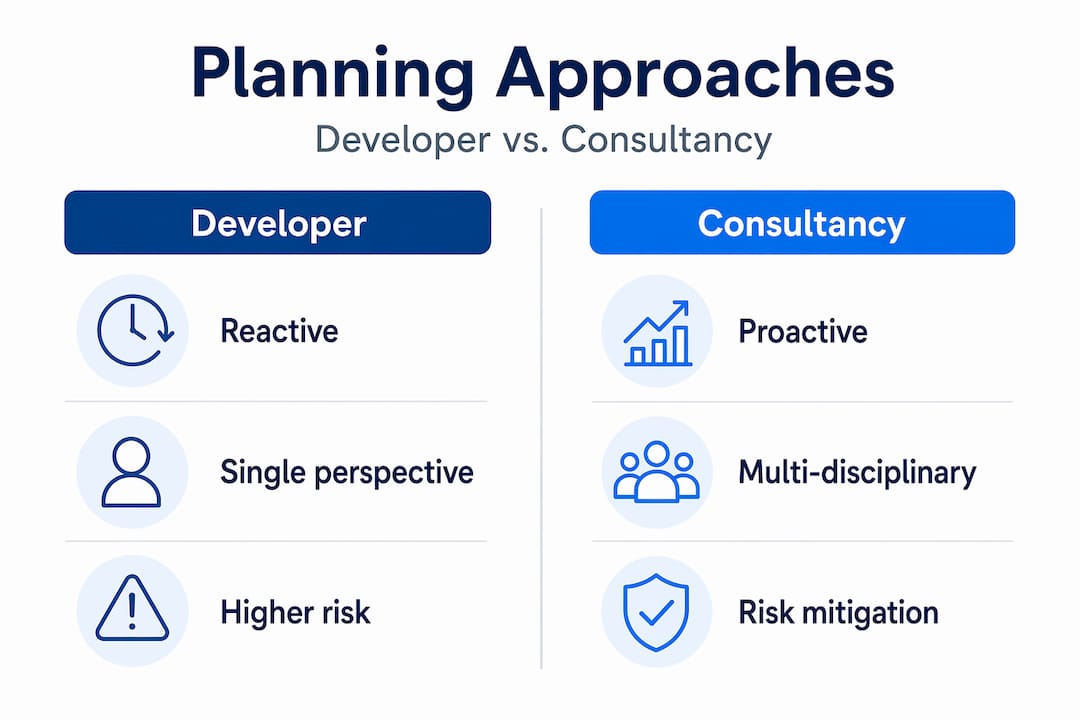
The table below summarizes the practical differences between developer-only project planning and consultancy-supported delivery in Singapore.
| Planning activity | Developer-only approach | Consultancy-supported approach |
|---|---|---|
| Feasibility assessment | Internal review, limited regulatory insight | Systematic site and authority constraint analysis |
| Submission preparation | Ad-hoc, risk of omissions | Structured, agency-specific documentation |
| Schedule management | Static program, reactive to delays | Dynamic baseline with deviation and recovery planning |
| Multi-agency coordination | Sequential and fragmented | Parallel, with pre-established authority relationships |
| Risk identification | Reactive post-design | Proactive pre-design and pre-submission |
| Compliance tracking | Manual, dependent on individual knowledge | Systematic with code update monitoring |
Engaging consultancy project management resources early in the project lifecycle is, therefore, not a luxury but a structural advantage that directly affects both schedule certainty and regulatory outcomes.

Consultancy’s role in compliance, risk mitigation, and authority approvals
Beyond broad project planning functions, consultancies deliver the most direct return on investment in the specific area of compliance management and authority approvals. This is where the financial consequences of inadequate advisory support are most visible and most measurable.
Frequent compliance breakdowns in Singapore projects typically originate from four root causes: incomplete documentation packages at submission, unapproved design changes introduced during construction, failure to track code amendments between design completion and submission, and inadequate coordination between the requirements of separate agencies governing the same project.
Consultancy regulatory expertise and local approval-process knowledge help reduce project risk and optimize outcomes by addressing these root causes systematically. Specifically:
- Submission completeness audits: Consultancies conduct pre-submission reviews against agency-specific checklists to eliminate incomplete documentation before packages reach the authority, preventing rejection cycles.
- Change management protocols: Any design change introduced after building plan approval is routed through a formal amendment submission process managed by the consultancy, preventing unauthorized modifications from triggering enforcement action.
- Code update monitoring: Consultancies maintain awareness of revisions to the BCA’s approved documents, URA’s development control advisories, and SCDF’s fire safety requirements, and they update project documentation accordingly.
- Schedule recovery planning: Consultants must have schedule recovery planning and delay analysis skills to manage baseline deviations when approval delays or construction disruptions occur.
The following table identifies the most common compliance delay scenarios in Singapore construction projects and the mitigation strategies that consultancies apply.
| Delay scenario | Typical impact | Consultancy mitigation strategy |
|---|---|---|
| Incomplete building plan submission | 4 to 12 weeks additional review cycle | Pre-submission completeness audit |
| Unapproved design change during construction | Stop-work order, rectification cost | Change management protocol and amendment submission |
| Code revision not incorporated | Rejection and resubmission | Continuous code monitoring and document updates |
| Multi-agency coordination failure | Parallel delays across submission tracks | Integrated submission schedule with agency liaison |
| Delay analysis not performed after disruption | Cascading milestone failures | Formal delay analysis and recovery program |
For developers evaluating the return on consultancy investment, the numbers are instructive. A four-week delay in a medium-scale commercial development in Singapore typically carries holding costs, extended financing charges, and loss of rental income that collectively far exceed the annual retainer of a full-service consultancy. The case for compliance planning success through professional management is therefore financially straightforward. Additionally, given Singapore’s stringent Design for Safety (DFS) requirements, integrating risk management in design through a qualified Risk Management Facilitator (RMF) is itself a statutory obligation for qualifying projects, making consultancy involvement a legal requirement rather than an option in these cases.
When and how to engage a consultancy for maximum value
Understanding the value that consultancies provide is only useful if it translates into a clear engagement strategy. The following steps provide a structured framework for developers and construction firms seeking to maximize consultancy returns.
-
Engage before feasibility is complete. Major advisory consultancies position their value-add in managing feasibility, due diligence, design and construction management, and statutory navigation. Bringing a consultancy in after the design brief has been fixed substantially reduces the benefit, since the highest-risk decisions have already been made without regulatory input.
-
Verify the consultancy’s agency relationships and track record. Before appointment, request evidence of recent comparable projects, specifically projects submitted to the same agencies your development will require. Ask for documented examples of baseline deviation recovery on projects of similar complexity.
-
Confirm the consultancy’s scope covers both scheduling and compliance. A common error is appointing separate advisors for program management and regulatory submission without a clearly defined coordination interface between them. Leading consultancies integrate these functions under a unified project delivery framework.
-
Assess the consultancy’s BIM capability. Singapore’s BCA mandates Building Information Modeling (BIM) submissions for projects above defined gross floor area thresholds. A consultancy without established BIM production and coordination capabilities introduces compliance risk at the submission stage.
-
Define the escalation protocol. Establish at appointment how the consultancy will communicate emerging compliance risks, schedule deviations, and authority clarifications. Projects fail most often when critical information is delayed in reaching decision-makers.
Pro Tip: Do not limit the consultancy’s role to compliance paperwork. Engage them for feasibility and due diligence work and consultancy project management functions, including baseline setting, deviation monitoring, and schedule recovery planning. These functions represent the most direct line between consultancy activity and project outcomes.
When evaluating how a consultancy augments an existing internal project team, the most effective model positions the consultancy as the regulatory interface and technical coordination layer, while internal project managers retain control of commercial decisions and stakeholder relationships. This division of responsibility prevents duplication and ensures that specialist knowledge is applied where it generates the greatest risk reduction.
Our perspective: Why the right consultancy is your best insurance
In practice, too many property developers in Singapore treat consultancy engagement as a procurement line item to be minimized rather than a strategic decision that shapes overall project risk exposure. This perspective is understandable but consistently produces worse outcomes.
The hard reality is that delays in Singapore’s approval-intensive environment cost significantly more than the consultancy fees required to prevent them. A project that loses four months to avoidable BCA resubmissions, or that faces a SCDF rejection requiring redesign of an entire fire escape strategy, will absorb costs in financing, holding, and redesign that no one budgeted for. The consultancy fee that would have prevented this scenario represents a fraction of the recovery cost.
What insiders know is that experienced consultancies do not merely respond to regulatory requirements. They anticipate agency concerns before submissions are lodged. They identify the interpretive ambiguities in development control guidelines and resolve them through pre-application consultation before design is committed. They recognize when a project’s proposed approach is technically compliant but likely to attract scrutiny, and they restructure submissions accordingly.
The most experienced developers in Singapore understand this dynamic. They do not ask whether to engage a consultancy. They ask which consultancy has the specific agency relationships and technical depth their project requires. The project management experience of the consultancy becomes a direct proxy for the likelihood of on-time, on-budget, compliant delivery.
The firms that treat consultancy as genuine project insurance rather than administrative overhead consistently report fewer approval cycles, fewer enforcement incidents, and faster paths to project completion. That outcome is not coincidental.
How Aman Engineering Consultancy supports your Singapore projects
Aman Engineering Consultancy brings specialized expertise across the full spectrum of project planning, statutory compliance, and authority approval requirements that Singapore’s construction and development sector demands.
Aman’s established experience covers regulatory navigation across BCA, URA, JTC, HDB, SCDF, PUB, and LTA, ensuring that your project’s submissions are complete, compliant, and structured to minimize approval cycles. The firm’s services include feasibility studies, structural and M&E consultancy, fire safety submissions, BIM production, and value engineering solutions designed to optimize project outcomes without compromising compliance. Aman also manages the full scope of streamlining authority approvals for projects at every scale, from industrial facilities to mixed-use commercial developments. Property developers and construction firms seeking consultancy support for their next Singapore project are invited to contact Aman Engineering Consultancy for a structured assessment of project requirements and an outline of how specialist advisory involvement can protect both timeline and budget.
Frequently asked questions
What specific regulatory approvals are required for construction projects in Singapore?
Most projects require approvals from agencies such as BCA, URA, and SCDF, covering structural safety, land use compliance, and fire safety, with additional submissions to JTC, HDB, PUB, or LTA depending on project type and location. Regulatory navigation expertise includes managing these local approval processes in an integrated manner to prevent inter-agency coordination failures.
How early should I involve a consultancy in my project planning?
Consultancies should be engaged before the feasibility study is finalized and certainly before any design brief is issued, as consultancy value includes feasibility, due diligence, and early-stage regulatory navigation that cannot be recovered once major design decisions are locked in.
Do consultancies handle both project scheduling and compliance paperwork?
Yes, leading consultancies in Singapore manage both functions, as planners must offer schedule recovery and delay analysis in addition to the statutory submission processes, ensuring that compliance activity and program management are coordinated rather than managed in isolation.
What makes Singapore’s project planning environment unique?
Singapore’s strict multi-agency regulatory system, combined with rapidly updating technical codes and sequential approval dependencies, creates a planning environment where a single missed requirement at one agency can generate cascading delays across the entire project. Singapore’s complex regulatory environment requires local expertise and established authority relationships to navigate effectively.
How do consultancies reduce the risk of project delays?
Consultancies identify compliance gaps during pre-submission audits, coordinate across multiple agencies to maintain parallel approval tracks, and apply delay analysis and authority coordination techniques to recover schedules when disruptions occur, preventing localized delays from becoming program-level failures.
Recommended
- Project Management – Aman Engineering Consultancy
- Singapore Construction Compliance Checklist: Ensure Project Approval
- M&E consultancy: Compliance, planning, and project success
- Benefits Of Working With Experienced Professionals To Ensure Smooth Plan Consent Applications In Singapore – Aman Engineering Consultancy