
Navigating Fire Compartmentation: SCDF Inspection Failures
Introduction to Building Fire Safety
Fire compartmentation is a critical building safety strategy. The Singapore Civil Defence Force mandates these rules.1 Consequently, buildings must contain fires within localized zones.1 This containment relies heavily on passive fire protection.2 Passive systems operate silently without requiring mechanical activation.3 Structural fire precautions achieve three primary life-safety objectives.1 First, they prevent fire spread between adjoining buildings.1 Second, they prevent untimely and catastrophic building collapse.1 Third, they restrict fire spread within building envelopes.1
However, safety inspections frequently reveal dangerous structural vulnerabilities.4 Structural joints and service penetrations commonly fail audits.4 Therefore, understanding these specific failures is critical today. Building owners face severe penalties for these breaches.5
Furthermore, unsealed gaps allow toxic smoke to spread.6 This report deeply analyzes these common inspection failures. It examines SCDF regulations alongside proven compliance strategies.7 Ultimately, proactive preparation prevents costly delays during construction.8
The Mechanics of Fire Compartmentation
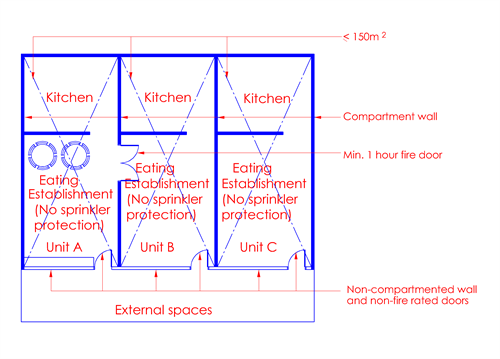
The SCDF Fire Code 2023 dictates modern requirements.7 Chapter 3 explicitly outlines structural fire precaution regulations.9 Specifically, compartment walls form the primary defensive barriers.10
These floors and walls must remain totally imperforate.10 Furthermore, they must provide complete physical fire barriers.10 Consequently, these structures must utilize entirely non-combustible materials.10 Combustible materials cannot cross these critical compartment lines.10
Beams and columns require equal fire resistance ratings.10 These supporting structures cannot rely on combustible assistance.10 Fire-resisting glass is strictly prohibited in residential separations.10 Additionally, separating walls mandate at least one-hour resistance.11
Fire doors must possess matching fire resistance ratings.9 Moreover, these doors require automatic self-closing mechanical devices.9
Building size heavily dictates the required compartmentation limits. Table 3.2A specifies exact floor area capacity restrictions.1 Below ground level, compartments cannot exceed one storey.9 The maximum allowable floor area is 2000 square meters.9
The maximum cubical extent is 7500 cubic meters.9 For building heights up to 24 meters, limits increase.9 Here, compartments can successfully span up to three storeys.9 The floor area cap rises to 4000 square meters.9 The cubical extent maximum becomes 15000 cubic meters.9
| Compartment Location Level | Maximum Storeys | Maximum Floor Area | Maximum Cubical Extent |
| Below average ground level | 1 Storey | 2000m² | 7500m³ |
| Between ground level and 24m | 3 Storeys | 4000m² | 15000m³ |
| Above 24m habitable height | 1 Storey | 2000m² | 7500m³ |
High-Rise Compartmentation Challenges
High-rise structures face far stricter regulatory audit scrutiny. Buildings exceeding 24 meters fundamentally change safety rules.9 Every single storey above 24 meters requires isolation.9 Consequently, no compartment can comprise more than one storey.9
The maximum floor area reverts to 2000 square meters.9 The cubical extent drops back to 7500 cubic meters.9
These smaller sizes assist complex firefighting and rescue operations.1 Unchecked fires in high-rise buildings cause catastrophic damage.12 The tragic Grenfell Tower fire perfectly illustrates this danger.12 Therefore, strict floor-by-floor isolation prevents rapid vertical spread.1
Exceptions exist for fully sprinkler-protected modern building designs.9 Sprinklers often remove strict floor area compartment restrictions entirely.9
Atrium designs complicate traditional compartmentation strategies quite immensely.1 SCDF permits atriums to span up to three storeys.1 However, the habitable height cannot exceed 24 meters total.1 Beyond this specific height, strict single-storey rules apply.1 Furthermore, fire shutters used near atriums require electronics.10 They must activate automatically during active smoke emergencies.10
The Vulnerability of Structural Joints
Structural joints represent planned separations within building envelopes.13 They accommodate natural building movement and reduce stress.13 Expansion joints prevent severe cracking from thermal changes.13
However, these necessary gaps create inherent fire safety risks.13 An unsealed joint provides a direct smoke pathway.14 Consequently, fire easily bypasses robust concrete compartment walls.
Joints demand specialized fire-resistive sealing systems for protection.15 These systems must withstand constant building mechanical movement.4
Simultaneously, they must block intense fire and smoke.4 Over time, dynamic joints experience significant mechanical fatigue.16 The fire-stopping sealants can dry, crack, or detach.4 Improper joint compounds fail under extreme thermal stress.17
SCDF inspectors actively search for these degraded seals.4 Even a minor 10mm gap causes audit failure.6 Toxic smoke travels rapidly through these tiny crevices.6
Therefore, comprehensive maintenance of joint seals is critical.4 Installers must use highly flexible, fire-rated mastic sealants.18 Rigid materials will inevitably crack during structural shifting.18
Corrosion and Structural Degradation
Corrosion heavily impacts structural steel joints and connections.16 Consequently, rust reduces the thickness of critical members.16 Moisture exposure accelerates this dangerous structural degradation process.16
This deterioration severely weakens structural anchors and brackets.16 When connections weaken, erratic structural movement increases significantly.16
This excessive movement tears adjacent fire-stopping sealants apart.16 Furthermore, structural steel possesses inherent thermodynamic vulnerabilities internally.19 Steel degrades rapidly at temperatures exceeding 427 degrees Celsius.3
Unprotected steel collapses catastrophically during intense cellulosic fires.3 Therefore, passive fire protection preserves vital structural stability.3
Inspectors often find corrosion where ambient water collects.16 Stair treads and platform connections are highly vulnerable.16
Furthermore, shifting platforms indicate severe underlying structural fatigue.16 Older buildings frequently exhibit compromised framing and rails.16 Regular periodic structural inspections must identify this corrosion early.3 Improper past cosmetic repairs fail modern safety standards.16
Service Penetrations: The Primary Breach
Modern commercial facilities require vast utility service networks. Mechanical, electrical, and plumbing systems snake through buildings.20 Cables, pipes, and ventilation ducts penetrate compartment walls.2 Each penetration fundamentally compromises the wall’s fire resistance.14 If improperly sealed, these holes act like chimneys.4 They draw toxic smoke and flames into safe zones.4
Unsealed penetrations represent the most common inspection failure.4 Clause 3.12 of the Fire Code governs breaches.21 Openings for pipes and cables must be strictly limited.21 Furthermore, they must be kept as few as possible.21
The openings must remain as small as practically possible.21 Installers must fill all resulting gaps incredibly thoroughly.21
SCDF inspectors scrutinize these specific annular gaps closely.22 The annular gap is the space surrounding pipes.22 This critical clearance requires highly specific sealing systems.22 Generally, no more than sixty percent remains unfilled.22 Oversized gaps cause sealants to slump and fail.6 Consequently, flames bypass the protective compartmentation barrier easily.6
Fire-Stopping Materials Under Clause 3.12
Not all commercial sealants provide adequate fire protection. Clause 3.12.3 explicitly lists acceptable fire-stopping materials.21 Materials must demonstrate adequate fire resistance through rigorous testing.21 The British Standard BS 476 dictates these tests.18 Acceptable traditional materials include standard cement mortar mixes.21 Gypsum-based plasters also provide excellent fire-stopping capabilities safely.21
Cement-based vermiculite and perlite mixes are widely approved.21 Modern construction frequently utilizes advanced intumescent mastic sealants.21 These chemical sealants react violently to high heat.21 They expand rapidly to fill melting pipe voids.6 Glass fiber and crushed rock products are permitted.21 Installers must choose materials perfectly appropriate for applications.21
Using incorrect materials guarantees an immediate inspection failure.4 The SCDF strictly prohibits untested or cosmetic applications.21
Sealants must penetrate the full depth of gaps.21 Unsupported fire-stopping spans exceeding 100mm require robust reinforcement.21 Consequently, builders must utilize materials of limited combustibility.21 Proprietary sealing systems remain the highly preferred option.21
| Allowed Fire-Stopping Material | Common Application Use Case | Fire Code Reference |
| Cement Mortar | Solid masonry wall structural penetrations | Clause 3.12.3 |
| Gypsum-based Plaster | Drywall and plasterboard compartment repairs | Clause 3.12.3 |
| Vermiculite / Perlite Mixes | Large floor voids and structural steel gaps | Clause 3.12.3 |
| Intumescent Mastics | Plastic pipes and melting combustible services | Clause 3.12.3 |
| Crushed Rock / Glass Fibre | Thermal insulation within fire-rated assemblies | Clause 3.12.3 |
The Product Listing Scheme (PLS) Mandate
SCDF heavily regulates fire safety products through PLS.23 This scheme ensures materials meet strict performance standards.23 The Singapore Accreditation Council accredits independent Certification Bodies.23 Organizations like TÜV SÜD and SETSCO manage this.24 Compliant products receive a formal Certificate of Conformity.23 Installers absolutely cannot use uncertified materials in Singapore.23
Fire-stopping materials belong to specific PLS certification classes.24 They require a Class 1A certification level generally.24 Scheme 1A demands rigorous initial type testing constantly.25 It also mandates annual factory surveillance and audits.26 SCDF monitors the manufacturing process to prevent degradation.24 Products must precisely match the originally tested specimen.24
Discrete products, like fire doors, receive serial labels.27 Non-discrete systems, like fire-stopping mastics, use DoC certificates.27 Declarations of Compliance prove materials meet Fire Code.23 SCDF penalizes manufacturers who supply varying substandard products.28 Misusing certification marks leads to immediate severe prosecution.28 Therefore, product authenticity remains a paramount compliance necessity.23
Common Fire-Stopping Installation Failures
Many compartmentation failures result from poor onsite workmanship. A frequent mistake involves using completely untested products.29 Contractors sometimes use standard polyurethane foam for gaps.30 This “pink foam” offers absolutely zero fire resistance.30 It burns rapidly and emits highly toxic smoke.30 Inspectors fail these specific careless installations immediately always.30
Mixing different product brands is another severe error.29 Fire-stopping components undergo testing as unified holistic systems.6 Using brand A’s sealant with brand B’s wool fails.6 This mixing invalidates the system’s certified fire rating.6 Every installation must adhere strictly to manufacturer instructions.6 Universal sealants simply do not exist in reality.6
Improper mineral wool installation causes countless hidden failures.31 Mineral wool requires highly specific mechanical compression levels.14 Workers often insert it with fibers running horizontally.31 Horizontal fiber orientation prevents proper mechanical compression completely.31 Insufficient compression dramatically shortens the assembly’s fire resistance.31 Consequently, fire destroys the compromised compartment partition quickly.31
Fire Collar and Intumescent Wrap Failures
Incorrect collar installation ruins plastic pipe fire stopping.6 Plastic pipes melt quickly, requiring expanding intumescent collars.4 These collars crush the melting pipe during fires.4 Drilling oversized holes prevents collars from gripping substrates.6 Under intense fire pressure, loose collars detach completely.6 This leaves a gaping hole for rapid fire spread.6
Installers must use all mechanical fixings exactly specified.6 Missing identification labels on collars trigger audit failures.4 Wraps suit smaller pipes embedded within solid masonry.6 Conversely, collars remain essential for flexible partition walls.6 Using an unapproved sealant around a plastic pipe fails.14 Metal pipe sealants cannot protect melting plastic penetrations.14
Furthermore, subsequent building maintenance often damages existing seals.4 IT technicians frequently pull new cables through walls.4 Often, they destroy the existing intumescent mastic completely.4 They rarely repair the resulting gap with compliant sealant.4 Fresh cables running through previously sealed areas fail.4 Facility managers must monitor all contractor renovation work.2
The Triangle of Responsibility Framework
Singapore relies on a robust professional accountability framework. This framework involves owners, QPs, and Registered Inspectors.32 The Qualified Person (QP) anchors this strict system.32 Only registered architects or professional engineers act as QPs.32 QPs design the fire safety systems and layouts.32 They legally certify that designs meet Fire Code.32
QPs submit detailed plans to SCDF through CORENET.32 This centralized digital platform heavily streamlines the process.32 The QP must diligently select PLS-certified stopping materials.23 They bear responsibility for verifying valid CoCs properly.23 QPs must ensure site materials match certificates exactly.23 Failing this fundamental verification process causes severe liabilities.23
If designs deviate from prescriptive codes, rules change.33 A Fire Safety Engineer must develop Performance-Based Designs.33 This involves complex fire modeling and evacuation simulations.33 This alternative approach handles massive, complex architectural structures.32 However, it transfers technical risk directly to specialists.32 SCDF heavily audits these intricate engineering design submissions.34
Registered Inspector (RI) Audits
The Registered Inspector provides independent verification of works.35 Owners must engage RIs to inspect completed projects.35 RIs absolutely cannot inspect projects they personally designed.36 Architectural RIs inspect compartment walls, floors, and stops.35 Mechanical RIs thoroughly test alarms, sprinklers, and ventilation.35 This deliberate separation ensures unbiased regulatory safety audits.35
RIs utilize highly comprehensive checklists during site walk-throughs.37 They verify that penetration seals match approved plans.38 They check the physical integrity of door smoke seals.39 RIs look for missing intumescent collars on pipes.4 They verify all PSB labels on installed fire doors.37 Any unsealed gap results in a failed RI inspection.6
After successful inspections, RIs issue specific certification forms.35 Form 1 indicates total compliance with all regulations.35 Form 2 indicates extremely minor, non-critical technical deviations.35 The SCDF requires these forms to issue permits.35 Building owners need these permits to legally occupy.35 RIs who falsify these crucial inspection reports face prosecution.35
| Defect Category | Common RI Inspection Observation | Risk Impact Level |
| Passive Compartmentation | Unsealed cable tray passing through drywall | Critical Failure |
| Passive Compartmentation | Horizontal mineral wool fiber orientation | Severe Downgrade |
| Fire Door Assemblies | Sagging hinges and ripped smoke seals | Critical Failure |
| Penetration Sealing | Oversized annular gap around metal pipe | Severe Downgrade |
| System Verification | Missing CoC or incorrect product labeling | Audit Rejection |
Navigating Common SCDF Audit Issues
QPs often fail preliminary audits due to errors.34 Missing professional endorsements delay plan approvals significantly often.34 Incomplete mechanical ventilation plans cause immediate SCDF rejections.40 QPs must secure necessary waivers before submitting plans.41 This proactive approach prevents costly delays during construction.41 Good documentation is critical for first-time SCDF approval.40
Missing fire safety details drastically slow building progress.40 Inspectors scrutinize exit numbers and travel distance requirements.34 Providing only one exit for huge crowds fails.34 Furthermore, inadequate fire protection facilities fail audits quickly.40 Installing the wrong type of sprinkler heads fails.40 Strict adherence to the Fire Code is non-negotiable.40
The SCDF strictly enforces these rules without compromise.40 Ignorance of the complex submission process costs money.40 Building owners suffer immense financial losses from delays.40 Therefore, coordinating with seasoned fire safety experts helps.40 Proper architectural planning avoids extensive onsite structural alterations.20 Planned penetrations are vastly superior to unplanned smash-throughs.20
SCDF Enforcement Statistics and Trends
SCDF maintains a remarkably rigorous active enforcement regime.42 They conduct many thousands of scheduled checks annually.42 In 2024, SCDF executed 15,075 fire safety checks.43 They utilize a Targeted On-Site Inspection Tool efficiently.44 This AI system predicts the likelihood of violations.44 High-risk premises face significantly more frequent SCDF audits.44
When violations occur, SCDF issues Hazard Abatement Notices.42 SCDF issued 2,579 FHANs during the 2024 year.43 These notices demand immediate rectification of identified hazards.42 Unsealed penetrations and blocked exits frequently trigger these.4 For severe offenses, SCDF issues Notices of Offence.42 SCDF issued 1,061 NOOs during the 2024 period.43
Furthermore, fire incidents rose across multiple property types.43 SCDF responded to 1,990 distinct fire incidents recently.43 Vegetation fires saw a massive statistical increase notably.43 They surged by over thirty-five percent that year.43 Residential fires remained mostly stable at 968 cases.43 Unattended cooking caused the majority of these fires.43
| Enforcement Action Type | 2023 Statistics | 2024 Statistics | Trend |
| Enforcement Checks | 15,044 | 15,075 | Slight Increase |
| Abatement Notices (FHAN) | 2,735 | 2,579 | Decrease |
| Notices of Offence (NOO) | 1,465 | 1,061 | Significant Decrease |
| Total Fire Incidents | 1,954 | 1,990 | Increase |
Unauthorized Changes and Layout Alterations
Unauthorized change of use remains a massive issue.45 It accounts for a huge percentage of offenses.46 Tenants often alter layouts without updating safety plans.40 They erect unauthorized partitions that disrupt sprinkler coverage.40 This creates new penetrations lacking proper fire-stopping systems.4 SCDF strictly monitors industrial premises for these alterations.46
A change of use drastically alters occupant loads.34 A warehouse converted to an office requires upgrades.34 Escape travel distances might suddenly exceed strict limits.34 Unapproved changes completely void the initial Fire Certificate.47 Consequently, building owners face immense legal liability risks.47 SCDF prosecutes owners who ignore these fundamental regulations.47
Furthermore, unapproved alterations can entirely void building insurance.48 Insurers demand strict adherence to all SCDF regulations.48 If illegal cladding remains, insurers slash coverage immediately.48 The lack of proper due diligence destroys policies.48 Correcting substandard work is significantly more expensive ultimately.6 Doing it right the first time saves money.6
Penalties Under the Fire Safety Act
Failing SCDF fire safety inspections triggers severe consequences.5 Building owners hold ultimate responsibility for maintaining systems.49 Under the Act, offenses carry incredibly heavy fines.5 Non-compliance results in fines reaching $10,000 per charge.5 Severe negligence easily leads to six months imprisonment.5 SCDF initiates court actions for persistent safety violations.43
Registered Inspectors also face harsh disciplinary actions routinely.35 SCDF can suspend an RI’s license for months.35 The Commissioner can cancel a fraudulent RI’s registration.50 RIs face personal fines up to $5,000 generally.50 This ensures RIs maintain extreme diligence during inspections.35 SCDF actively polices the integrity of these professionals.35
Financial repercussions extend far beyond simple regulatory fines. Remedial fire-stopping work disrupts business operations very severely.6 Tearing down pristine ceilings to fix hidden penetrations hurts.6 Closing a restaurant due to FSSD failure bankrupts.40 Furthermore, negative safety audits destroy corporate public reputations.40 Compliance is a non-negotiable operational necessity in Singapore.40
Maintaining Passive Fire Protection Systems
Passive fire protection is not a purely static feature. It requires ongoing vigilant maintenance to remain effective.51 General building use inevitably causes severe structural damage.39 Heavy carts constantly smash into sensitive fire doors.39 This physical abuse rips smoke seals off hinges.39 Consequently, the fire door fails its annual inspection.39
Building owners must secure a valid Fire Certificate.52 This certificate proves the building maintains its systems.52 Owners must renew this certificate to ensure compliance.52 The renewal process requires rigorous testing by engineers.52 SCDF will implement a three-year validity period soon.53 This reduces compliance costs while maintaining high standards.53
Fire Safety Managers (FSM) handle these daily tasks.52 They ensure evacuation routes remain clear of clutter.54 They prevent tenants from propping fire doors open.54 Propping a fire door open destroys compartmentation instantly.54 FSMs maintain critical emergency response plans for occupants.52 Their diligence prevents minor issues from becoming disasters.52
Advanced Compliance and Audit Strategies
Ensuring perfect fire compartmentation requires highly structured management. Property owners must eliminate “one-size-fits-all” sealant mentalities immediately.6 Specialists must select precise materials for precise penetrations.22 Comprehensive fire safety documentation is absolutely vital today.55 Historically, fragmented paper records caused massive inspection confusion.55 Missing documents guarantee an immediate FSSD submission rejection.40
Digital record-keeping transforms the modern fire safety audit.55 Installers should photograph every single penetration before concealment.56 These digital registers prove compliance directly to RIs.56 Furthermore, facility managers must conduct their own audits.54 Checking fire doors quarterly prevents smoke seal degradation.54 Logging every service visit simplifies future SCDF audits.57
MEP engineers must coordinate service pathways incredibly early.20 Early coordination prevents unplanned holes from being smashed.20 Pre-formed service openings allow much easier fire-stopping installation.20 Furthermore, rigorous training is paramount for long-term success.58 Only certified professionals should install critical protection systems.58 Ignorant contractors destroy perfectly good fire compartmentation designs.30
Protecting Vertical Shafts and Corridors
Fires in tall structures spread rapidly through shafts.59 The SCDF dictates strict rules for vertical protection.59 Staircases and lift shafts enable rapid human movement.59 Service shafts carry extensive cabling and plumbing lines.59 These shafts must possess immense fire resistance ratings.59 Protecting structures act as crucial elements of structure.59
A failed penetration inside a vertical shaft kills. It allows toxic smoke to bypass horizontal compartments. SCDF prohibits unapproved services inside protected escape staircases.59 Washrooms cannot exist inside an exit staircase enclosure.59 Halving the fire resistance of a shaft wall fails.59 It dramatically increases the threat of structural collapse.59
Furthermore, exit corridors require complete and absolute protection.9 The 2023 Fire Code explicitly tightens evacuation protocols.60 Emergency lighting must illuminate these critical escape paths.37 RIs meticulously verify gap clearances on exit doors.37 No locking devices can impede emergency exit routes.37 Compartmentation ensures these routes remain tenable during emergencies.59
The Future of SCDF Fire Safety
Singapore constantly updates its codes to address risks. The SCDF reviews regulations based on international disasters.60 The 2023 Fire Code integrates sustainable technology provisions.61 New rules cover electric vehicle charging station risks.61 Energy Storage Systems face stringent fire compartmentation regulations.61 As buildings utilize renewables, new electrical risks rise.62
Tighter compartmentation prevents battery fires from destroying facilities.62 Furthermore, smart technologies now integrate with safety systems.60 SCDF’s Transformation 2030 vision emphasizes data and technology.63 Predictive modeling identifies failing components before fires ignite.44 SCDF utilizes firefighting robots and load-bearing worker exoskeletons.64 These innovations keep emergency responders vastly safer physically.64
However, physical compartment walls remain fundamentally and utterly irreplaceable. Proper fire-stopping of joints and penetrations saves lives. Building professionals must fiercely respect passive fire protection. Ignorance of the PLS rules causes dangerous buildings. Constant vigilance ensures Singapore’s vertical landscape remains safe. Navigating these exhaustive regulations defines modern architectural success.
Works cited
- SCDF Fire Compartmentation Guidelines | PDF | Fire Sprinkler System | Kitchen – Scribd, accessed March 29, 2026, https://www.scribd.com/document/321435117/Singapore-Building-Code-2013-Chapter-3-Compartmentalisation
- Regulations and Requirements for Fire Compartmentation – CLM Fireproofing, accessed March 29, 2026, https://clmfireproofing.com/regulations-and-requirements-for-fire-compartmentation/
- Fire Safety in Structural Steel – Aman Engineering Consultancy, accessed March 29, 2026, https://www.amanengineering.com.sg/fire-safety-in-structural-steel/
- How to Spot Common Fire-Stopping Failures in Joints, Penetrations & Voids, accessed March 29, 2026, https://artiusfp.co.uk/2025/10/13/how-to-spot-common-fire-stopping-failures-in-joints-penetrations-voids/
- Fire Certificate – Singapore – SCDF, accessed March 29, 2026, https://www.scdf.gov.sg/fire-safety-services-listing/permits-and-certifications/fire-certificate
- Common Fire Stopping Installation Mistakes: Ensuring Statutory Compliance in 2026, accessed March 29, 2026, https://www.nationalfireltd.co.uk/common-fire-stopping-installation-mistakes-ensuring-statutory-compliance-in-2026/
- Fire Code 2023 – Singapore – SCDF, accessed March 29, 2026, https://www.scdf.gov.sg/fire-safety-services-listing/fire-code-2023
- Preparing for an SCDF Fire Safety Inspection: Tips for Success – National City Corporation, accessed March 29, 2026, https://nationalcitycorporation.sg/preparing-for-an-scdf-fire-safety-inspection-tips-for-success/
- Clause 3.2 Provision of Compartment Walls and Compartment Floors – SCDF, accessed March 29, 2026, https://www.scdf.gov.sg/fire-safety-services-listing/fire-code-2023/table-of-content/chapter-3-structural-fire-precautions/clause-3.2-provision-of-compartment-walls-and-compartment-floors
- Clause 3.7 Compartment Walls and Compartment Floors – SCDF, accessed March 29, 2026, https://www.scdf.gov.sg/fire-safety-services-listing/fire-code-2023/table-of-content/chapter-3-structural-fire-precautions/clause-3.7-compartment-walls-and-compartment-floors
- Clause 3.3 Fire Resistance of Elements of Structure – SCDF, accessed March 29, 2026, https://www.scdf.gov.sg/fire-safety-services-listing/fire-code-2023/table-of-content/chapter-3-structural-fire-precautions/clause-3.3-fire-resistance-of-elements-of-structure
- Second Reading of the Fire Safety (Amendment) Bill – Speech by Ms Sun Xueling, Senior Parliamentary Secretary, Ministry of Home Affairs and Ministry of National Development, accessed March 29, 2026, https://www.mha.gov.sg/media-room/newsroom/second-reading-of-the-fire-safety-amendment-bill—speech-by-ms-sun-xueling-senior-parliamentary-secretary-ministry-of-home-affairs-and-ministry-of-national-development/
- Dos and Don’ts of Specifying Expansion Joints in a Structure | Waterproofing Contractor Singapore, accessed March 29, 2026, https://www.lefong.sg/dos-and-donts-of-specifying-expansion-joints-in-a-structure/
- The perfect firestopping solution: 8 mistakes to avoid if you wish to set it up – Promat, accessed March 29, 2026, https://www.promat.com/en-sg/construction/projects/expert-area/221635/firestopping-solution-mistakes/
- Inspection Guidelines – International Firestop Council, accessed March 29, 2026, https://firestop.org/the-source-of-firestop-expertise/inspection-guidelines/
- Common Structural Problems Found During Fire Escape Inspections, accessed March 29, 2026, https://www.atlanticironworkrestoration.com/single-post/common-structural-problems-found-during-fire-escape-inspections
- Sustainable Construction, accessed March 29, 2026, https://sustainable-fire-engineering.sustainable-design.ie/wp-content/uploads/2015/05/Singapore_Sustainable-Construction_Fire-Protection-Guide_2008.pdf
- Clause 3.12 Fire stopping – SCDF, accessed March 29, 2026, https://www.scdf.gov.sg/fire-safety-services-listing/cpfprts-2022/table-of-content/chapter-3-station-structural-fire-precautions/clause-3.12-fire-stopping
- Structural steel fireproofing SCDF compliance : Intumescent vs. Vermiculite, accessed March 29, 2026, https://www.amanengineering.com.sg/structural-steel-fireproofing-scdf-compliance-intumescent-vs-vermiculite/
- A Guide to Firestopping: Getting It Right for the Future | UL Solutions, accessed March 29, 2026, https://www.ul.com/resources/guide-firestopping-getting-it-right-future
- Clause 3.12 Fire Stopping – SCDF, accessed March 29, 2026, https://www.scdf.gov.sg/fire-safety-services-listing/fire-code-2023/table-of-content/chapter-3-structural-fire-precautions/clause-3.12-fire-stopping
- Tips & Tricks for Fire Stopping – Promat, accessed March 29, 2026, https://www.promat.com/en/construction/firestoppingforarchitects/tipsandtricks/
- Regulated Fire Safety Products – Singapore – SCDF, accessed March 29, 2026, https://www.scdf.gov.sg/fire-safety-services-listing/plans-submission-process/regulated-fire-safety-products
- Product Requirements | TÜV SÜD PSB Singapore, accessed March 29, 2026, https://www.tuvsud.com/en-sg/resource/certificate-finder/product-listing-scheme/product-requirements
- Fire Safety Products – Singapore – Setsco, accessed March 29, 2026, https://www.setsco.com/services/fire-safety-products/
- Certification Requirements for CODIMI Product Listing Scheme (PLS), accessed March 29, 2026, https://codimiglobal.com/certification-requirements-for-codimi-product-listing-scheme-pls/
- Certification of Fire Safety Product | MY – TUV Rheinland, accessed March 29, 2026, https://www.tuv.com/malaysia/en/product-listing-scheme.html
- Clause 11.2 Definition – Singapore – SCDF, accessed March 29, 2026, https://www.scdf.gov.sg/fire-safety-services-listing/fire-code-2023/table-of-content/chapter-11-regulated-fire-safety-products-and-materials/clause-11.2-definition
- The 4 Most Common Firestopping Mistakes – Tremco CPG APAC, accessed March 29, 2026, https://www.tremcocpg-asiapacific.com/blog/the-4-most-common-firestopping-mistakes
- The 5 most common mistakes in firestopping – Sharpfibre, accessed March 29, 2026, https://www.sharpfibre.com/the-5-most-common-mistakes-in-firestopping/
- 12 common deficiencies found during Firestopping Inspections Introduction, accessed March 29, 2026, https://firestop.org/wp-content/uploads/2024/02/top_12_firestop_deficiencies_astmpaper_preprint_published_by_ifc.pdf
- Guide to Fire Engineering Design & SCDF Compliance in Singapore: A 2025 Industry Report – Stellar Structures, accessed March 29, 2026, https://structures.com.sg/fire-engineering-design-scdf-compliance-sg/
- Clause 3.4 Tests of Fire Resistance – SCDF, accessed March 29, 2026, https://www.scdf.gov.sg/fire-safety-services-listing/fire-code-2023/table-of-content/chapter-3-structural-fire-precautions/clause-3.4-tests-of-fire-resistance
- SCDF Common Audit Issues Overview | PDF | Stairs | Bathroom – Scribd, accessed March 29, 2026, https://www.scribd.com/document/613110250/Common-SCDF-Audit-Issues
- Registered Inspector – Singapore – SCDF, accessed March 29, 2026, https://www.scdf.gov.sg/fire-safety-services-listing/permits-and-certifications/registered-inspector
- Fire Safety (Registered Inspectors) Regulations – Singapore Statutes Online, accessed March 29, 2026, https://sso.agc.gov.sg/SL/FSA1993-RG2?DocDate=20200911
- Arch Ri Inspection Checklist | PDF | Door | Firefighting – Scribd, accessed March 29, 2026, https://www.scribd.com/document/792078650/Arch-Ri-Inspection-Checklist
- Ri Inspection Checklist Summary | PDF | Elevator | Wall – Scribd, accessed March 29, 2026, https://www.scribd.com/document/792078939/RI-INSPECTION-CHECKLIST-SUMMARY
- Top 3 Reasons for Fire Door Inspection Failures – REMEDI8®, accessed March 29, 2026, https://www.myremedi8.com/top-3-reasons-for-fire-door-inspection-failures/
- Avoid Rejection: Fire Safety & Shelter Department Singapore – CMM Food Consultancy, accessed March 29, 2026, https://www.cmmfc.com/post/why-food-businesses-fail-fire-safety-and-shelter-department-fssd-inspections-in-singapore
- Common Fire Safety Audit Findings | PDF – Scribd, accessed March 29, 2026, https://www.scribd.com/document/906958238/Common-audit-issues-IES-2025-For-Circulation
- FSM BRIEFING 2021 – Enforcement Statistics & Common Fire Safety Non-Compliances – SCDF, accessed March 29, 2026, https://www.scdf.gov.sg/docs/default-source/fire-safety-docs/fire-safety-manager-(fsm)/fsm-2021/fsm-briefing-2021—enforcement-statistics-and-common-fire-safety-non-compliances.pdf?sfvrsn=866a21e1_1
- SCDF releases 2024 emergency response and fire safety statistics, accessed March 29, 2026, https://internationalfireandsafetyjournal.com/scdf-releases-2024-emergency-response-and-fire-safety-statistics/
- FSM Seminar 2025 Common Fire Safety Enforcement Findings – SCDF, accessed March 29, 2026, https://www.scdf.gov.sg/docs/default-source/fire-safety-docs/fire-safety-manager-(fsm)/fsm-2025/common-fire-safety-enforcement-findings.pdf
- SINGAPORE CIVIL DEFENCE FORCE FIRE AND AMBULANCE STATISTICS TOPIC 3 FIRE SAFETY ENFORCEMENT STATISTICS (JAN – DEC 2009), accessed March 29, 2026, https://www.scdf.gov.sg/docs/default-source/media-room-(publications)/annual-statistics/enforcement_stats_2009.pdf?sfvrsn=da39e76b_1
- TOPIC C FIRE SAFETY ENFORCEMENT STATISTICS (JANUARY – DECEMBER 2013) – SCDF, accessed March 29, 2026, https://www.scdf.gov.sg/docs/default-source/media-room-(publications)/annual-statistics/scdf-enforcement-stats-2013.pdf?sfvrsn=9d91d459_1
- Fire Safety Guide – IX Architects Pte Ltd, accessed March 29, 2026, https://ixa.com.sg/fire-safety-guide/
- Two dozen Singapore buildings fail fire safety checks – Insurance Business, accessed March 29, 2026, https://www.insurancebusinessmag.com/asia/news/breaking-news/two-dozen-singapore-buildings-fail-fire-safety-checks-81147.aspx
- Appendix 01 – Fire Safety Report – SCDF, accessed March 29, 2026, https://www.scdf.gov.sg/fire-safety-services-listing/fire-code-2023/table-of-content/appendix-01/appendix-01-fire-safety-report
- Fire Safety Act – Singapore Statutes Online, accessed March 29, 2026, https://sso.agc.gov.sg/Act-Rev/FSA1993/Published/20211231?DocDate=20001230
- Singapore Fire Protection System And Alarm Maintenance 2025 – National City Corporation, accessed March 29, 2026, https://nationalcitycorporation.sg/singapore-fire-protection-system-and-alarm-maintenance-2025/
- Non-Compliances Found For Fire Safety Certificate and Fire Certificate Inspections – SCDF, accessed March 29, 2026, https://www.scdf.gov.sg/docs/default-source/fire-safety-docs/fire-safety-manager-(fsm)/fsm-2018/non-compliances-found-for-fire-safety-certificate-and-fire-certificate-inspections.pdf?sfvrsn=3c2eaac6_1
- Clause 3.6 Penetration of Services – SCDF, accessed March 29, 2026, https://www.scdf.gov.sg/home/civil-defence-shelter/acts-and-requirements/technical-requirements-for-household-shelters-2023/chapter-3-structural-requirements/clause-3.6-penetration-of-services
- SCDF Fire Safety Inspection Checklist 2025 Singapore – National City Corporation, accessed March 29, 2026, https://nationalcitycorporation.sg/scdf-fire-safety-inspection-checklist-2025-singapore/
- Addressing 4 common challenges in building fire audits: Solutions and best practices, accessed March 29, 2026, https://www.planradar.com/sg/4-common-challenges-in-building-fire-audits/
- Fire Stopping and Penetrations Inspection Checklist – Quollnet, accessed March 29, 2026, https://quollnet.com/chk/construction/fire-stopping-penetrations-inspection
- Fire Alarm Maintenance And Fire Safety Inspection Singapore – National City Corporation, accessed March 29, 2026, https://nationalcitycorporation.sg/fire-alarm-maintenance-and-fire-safety-inspection-singapore/
- Tips & Tricks for Fire Stopping – Promat, accessed March 29, 2026, https://www.promat.com/fr-lu/construction/firestoppingforinstallers-old-v1/tips-tricks/
- Clause 3.8 Protected Shafts – SCDF, accessed March 29, 2026, https://www.scdf.gov.sg/fire-safety-services-listing/fire-code-2023/table-of-content/chapter-3-structural-fire-precautions/clause-3.8-protected-shafts
- Navigating the New Singapore Fire Code 2023: Key Updates and Implications for Building Design and Management – Hector, accessed March 29, 2026, https://hector.com.sg/news/industry-news/navigating-the-new-singapore-fire-code-2023-key-updates-and-implications-for-building-design-and-management/
- Foreword & Acknowledgement – SCDF, accessed March 29, 2026, https://www.scdf.gov.sg/fire-safety-services-listing/fire-code-2023/foreword-and-acknowledgement
- Empowering Clients with SCDF-Recognized Fire Safety Certification | SGS Italy, accessed March 29, 2026, https://www.sgs.com/en-it/news/2025/03/empowering-clients-with-scdf-recognized-fire-safety-certification
- Table of Contents – SCDF, accessed March 29, 2026, https://www.scdf.gov.sg/fire-safety-services-listing/fire-code-2023/table-of-content
7 cool pieces of technology SCDF is using – GovTech Singapore, accessed March 29, 2026, https://www.tech.gov.sg/technews/7-cool-pieces-of-technology-scdf-is-using/