
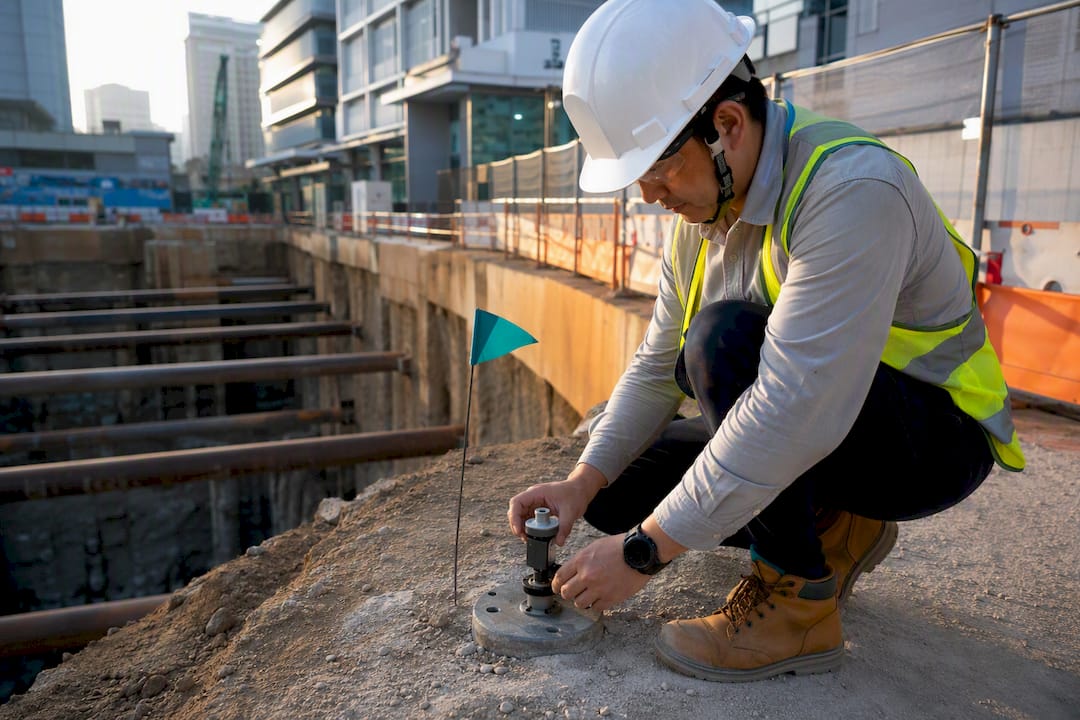
Submit an ERSS plan to BCA whenever the works include earth retaining or stabilizing structures beyond general excavation thresholds, or when excavation adjoins another property. Engage a Professional Engineer (Geotechnical) immediately, confirm whether the works fall under Geotechnical Building Works, and assemble the site investigation and monitoring plan before packaging the CORENET X independent submission. Higher-risk works also require an independent checker before endorsement.
TL;DR:
- Submitting ERSS plans is mandatory for earth retaining works crossing excavation thresholds or adjoining property boundaries, especially in high-risk or sensitive locations.
- The submission package must include comprehensive site investigation data, geotechnical reports following Eurocode 7, and detailed design calculations with a clear construction sequence and monitoring plan.
- Endorsements from the qualified geotechnical engineer, structural engineer, and independent checker must precisely match the latest revisions and be verified before final upload.
- Correct classification as an independent ERSS submission on CORENET X prevents system rejections, with strict adherence to file naming, metadata, and endorsement verification.
- Proper early coordination, thorough site investigation, and specific movement criteria streamline review, reduce delays, and lower the risk of costly rework.
Table of Contents
- What Counts as an ERSS Submission and When Is It Required?
- Who Must Endorse: QP(Geo), QP(ST), and the Independent Checker
- Submission Documentation Checklist: What an ERSS Plan Must Include
- How Does the CORENET X ERSS Submission Workflow Actually Work?
- Temporary vs. Permanent ERSS: What Changes in the Submission?
- Common ERSS Submission Mistakes That Cause Delays
- What Do ERSS Submissions Typically Cost and How Long Do They Take?
- A Practical Pre-Submission Checklist for Qualified Persons
- What We’ve Learned Handling ERSS Submissions in Singapore
- How Aman Engineering Consultancy Supports ERSS Submissions
- Sources
What Counts as an ERSS Submission and When Is It Required?
Earth Retaining and Stabilising Structures cover any system designed to hold back soil, retain an excavation face, or stabilize a slope during or after construction. That definition sounds broad because it is meant to be. BCA’s ERSS – Submission Requirements guidance treats almost any structural intervention in the ground as falling within scope once it interacts with an excavation or a slope face.
The most common ERSS types a QP will encounter in Singapore include:
- Sheet pile walls, typically for shallower or temporary excavations near roads or drains
- Contiguous and secant bored pile walls, used where groundwater control and stiffness matter
- Diaphragm walls, common on deep basements and MRT-adjacent works
- Soil nailing systems, often paired with shotcrete facing on slopes
- Ground anchors, used to tie back retaining walls where propping is impractical
- Slope stabilization works, including regrading and reinforced earth systems
An ERSS submission becomes mandatory once excavation depth crosses the thresholds set out in BCA guidance, or once the works sit close enough to a boundary, road, or existing structure that ground movement could affect a third party. Adjacency, not depth alone, is often the trigger that catches inexperienced project teams off guard. A shallow excavation next to an old shophouse with unknown foundations can demand the same rigor as a much deeper dig in open ground.
Whether a project is classified as Geotechnical Building Works changes the entire submission obligation. GBW status typically applies where excavation depth, proximity to sensitive structures, or ground conditions raise the risk profile enough that BCA requires a dedicated PE (Geotechnical) endorsement and, in higher-risk cases, an independent check. The Geotechnical Building Works – Submission Requirements guidance sets out worked examples of what qualifies, and it is worth reading in full rather than relying on secondhand summaries, because the boundary between “general excavation” and “GBW” is not always intuitive from drawings alone.
Once a project is flagged as GBW, the submission package expands considerably. It is no longer just a structural drawing set with a cover letter. Reviewers expect a coherent geotechnical narrative: ground model, design assumptions, calculation basis, and a monitoring regime that matches the assessed risk. Getting this classification wrong at the outset is one of the most expensive mistakes a QP can make, because it usually means restarting the documentation exercise after BCA flags the omission.
Who Must Endorse: QP(Geo), QP(ST), and the Independent Checker
BCA’s Guidelines for ST Plan Applications sets the statutory backbone for who can sign what, and it groups ERSS and slope submissions under structural plan requirements even though the geotechnical content dominates the package. Getting the appointment sequence right matters as much as getting the design right, because a missing or mismatched endorsement is one of the fastest ways to have a submission bounced before a reviewer even reads the calculations.
Three roles typically appear on an ERSS package, and each has a distinct scope:
- Professional Engineer (Geotechnical) takes ownership of the ground model, the site investigation interpretation, the ERSS design calculations, and the movement predictions. This is the endorsement that anchors the entire geotechnical narrative.
- QP(ST) coordinates the structural interface, particularly where the ERSS ties into permanent structural elements, basement walls, or superstructure loading paths that depend on the retaining system’s performance.
- Independent checker reviews the design for higher-risk GBW, typically where excavation depth, groundwater conditions, or adjacency to sensitive structures push the project past BCA’s independent-check thresholds. This role must remain organizationally separate from the design team to preserve the check’s integrity.
The handoff points between these roles are where gaps most often appear. A QP(Geo) might finalize ground movement predictions without confirming that the QP(ST) has incorporated those movements into the adjacent structure’s assessment. An independent checker might flag a discrepancy in lateral earth pressure assumptions weeks into review, well after the design team assumed the numbers were settled. BCA circulars on QP appointment duties clarify when a single QP arrangement is permissible and when separate appointments are required, and reading the current circular before assuming last year’s arrangement still applies is not optional. Our internal breakdown of QP(ST), QP(Geo), and AC(Geo) roles walks through these boundaries project by project.
Pro Tip: Confirm the independent checker’s appointment letter references the specific ERSS package and revision number before endorsement. A generic appointment letter that predates the final design iteration is a common reason reviewers ask for resubmission of the endorsement page alone, which adds days to an otherwise complete package.
Before uploading anything, run through a short confirmation checklist: does every drawing sheet carry the correct QP’s registration number and stamp; does the geotechnical report’s cover page match the PE(Geo)’s current practising certificate; has the independent checker signed the specific calculation revision being submitted, not an earlier draft; and do the declared roles on the CORENET X form match the physical endorsements on the PDF set. Skipping this last cross check is how mismatched revisions slip through internal QA and land as a rejection at BCA’s desk.
Submission Documentation Checklist: What an ERSS Plan Must Include
BCA reviewers work through an ERSS package methodically, and the ERSS – Submission Requirements guidance lays out what they expect to find at each stage. Missing or incomplete items in this checklist account for a large share of first-round review comments, so treating it as a genuine pre-submission audit rather than a formality saves real time later.
Site investigation and geotechnical data. The SI program needs to be dense enough, and deep enough, to characterize the ground through the full influence zone of the excavation, not just the footprint. Borehole logs, in-situ testing, and laboratory results should be formatted according to AGS(SG) conventions so the raw data can be checked electronically rather than re-keyed by a reviewer. Where existing SI data from a neighboring project is reused, the package needs to state its provenance and relevance explicitly.
Geotechnical report. The report should derive characteristic values in line with Eurocode 7, not simply average the raw SI numbers. BCA’s guide on ground investigation and geotechnical characteristic values to EC7 sets out the expected derivation method, including how to treat variability and how conservative the characteristic value should be relative to the mean. Laboratory test annexes, calibration certificates, and a clear statement of the ground model’s limitations belong in this report, not scattered across separate appendices.
Design calculations and structural drawings. Every ERSS calculation package should state its design method explicitly: limit equilibrium, finite element, or a hybrid approach, along with the software and version used. Drawings need to show the full construction sequence, not just the final retained condition, because ground movement often peaks mid-sequence rather than at completion. Ground model assumptions used in the calculations should match, sheet for sheet, the assumptions stated in the geotechnical report; discrepancies between these two documents are a frequent source of review queries.
Monitoring plan and movement criteria. This is arguably the section BCA scrutinizes hardest, and for good reason. The plan needs an instrumentation schedule (inclinometers, settlement markers, piezometers, tilt monitors as relevant), specific alert and action levels tied to predicted movements, and a reporting cadence that matches the construction program’s pace rather than a generic weekly default. Vague movement criteria, phrased as “monitor and act as necessary,” almost guarantee a request for information.
Record-piling, amendments, and temporary works. Where piling records exist from earlier stages, they should be cross-referenced against the current ERSS design rather than submitted as a disconnected attachment. Amendment sheets need clear revision labeling so reviewers can identify exactly what changed between submissions. Temporary works method statements covering propping sequences, strut removal, and any staged backfilling should accompany the main package, and drawings protecting adjacent structures, including underpinning details where relevant, need their own dedicated sheet set rather than being buried inside general layout drawings.
A package that gets this checklist right on the first pass tends to move through review noticeably faster than one that arrives complete on paper but scattered in organization. Reviewers are working through dozens of submissions; a package that mirrors their expected document sequence gets read faster and queried less.
How Does the CORENET X ERSS Submission Workflow Actually Work?
ERSS is typically submitted as an independent submission under the current RABW (without phasing) arrangement, not bundled into a Part ST application. This single classification point causes more system-level rejections than almost anything else in the process, according to CORENET X’s Part ST and independent submission guidance. Firms accustomed to phased Part ST submissions sometimes try to route ERSS the same way and get an immediate system rejection because the platform simply does not recognize that pathway for this class of work.
Packaging the submission correctly on CORENET X takes a bit of discipline:
- Confirm the submission type before touching the upload interface. Verify with the current CORENET X guidance whether the specific project falls under independent submission or another RABW arrangement, since misclassification here cascades into every subsequent step.
- Standardize file naming across the whole package. Reviewers and the platform itself expect consistent naming conventions between drawings, calculations, and the geotechnical report; inconsistent naming slows down internal cross referencing on BCA’s side.
- Populate mandatory metadata fields accurately, including project reference, QP registration details, and revision status, before attaching documents rather than after.
- Attach SI files in the correct AGS(SG) format alongside the PDF geotechnical report, since a PDF alone without the underlying data file is often treated as incomplete.
- Verify every endorsement digitally matches the physical signature block on the drawings before final submission, since a mismatch between the declared endorser and the uploaded signature page is a common automatic flag.
Missing endorsements and misclassified submission types together account for a large share of the rejections that never even reach a human reviewer’s queue; the system flags them structurally. Running a dry check against the current CORENET X checklist before the final upload catches most of these issues in minutes rather than after a multi-day wait for a bounce notice. Our own CORENET X submission guide walks through the platform’s current interface in more detail.
Pro Tip: Before your final CORENET X upload, open every PDF in the package on a separate device and check that stamps, signatures, and revision numbers render correctly. Files that display fine on a design workstation sometimes render endorsement stamps as blank on the platform’s viewer, and that alone can trigger a rejection notice.
Once a package clears the initial system checks, BCA’s review moves into substantive comments, typically arriving as a structured list of queries rather than a blanket approval or rejection. Administrative timelines vary by project complexity and current review load, so treat any specific day count you hear from another firm as anecdotal rather than a guarantee. What is consistent is the pattern: incomplete or inconsistent packages generate more comment rounds, and each round adds real calendar time to a project’s critical path.
Temporary vs. Permanent ERSS: What Changes in the Submission?
BCA does not apply a single uniform standard to every ERSS package. Temporary works, meaning structures designed to serve only through the construction period, are assessed against a defined design-life window and can use partial safety factors calibrated to that shorter exposure. Permanent ERSS, by contrast, needs to demonstrate performance across the building’s full service life, which typically pushes the design toward more conservative assumptions and a longer-term durability case for materials in contact with the ground.
That distinction does not mean temporary works get an easier submission path. A deep temporary excavation next to an occupied building or live MRT tunnel still demands the same geotechnical rigor as a permanent structure, because the consequence of ground movement during construction can be just as severe as a long-term failure. BCA’s classification hinges on exposure duration and consequence, not on how the works are labeled in a project brief.
Documentation differences between the two typically show up in a few specific places:
- Design-life statements: permanent ERSS packages need an explicit service-life declaration and a durability strategy; temporary works state the construction program duration instead.
- Safety factor justification: temporary works can reference partial factors appropriate to a shorter design life, but the justification for using them still needs to appear in the calculation package, not just be assumed.
- Monitoring duration: permanent structures may require post-construction monitoring provisions written into the maintenance regime; temporary works monitoring typically ends once the retaining system is decommissioned or the permanent structure takes over load paths.
- Decommissioning or conversion details: where a temporary system will later be removed, or where it converts into part of the permanent works (a common approach with diaphragm walls that become basement walls), the submission needs to address that transition explicitly.
Our comparison of temporary versus permanent ERSS submission requirements covers how these distinctions play out across different foundation types, and it is worth reviewing before assuming a temporary classification will simplify the paperwork. It rarely does when adjacency risk is high.
Common ERSS Submission Mistakes That Cause Delays
Most rejected or heavily queried ERSS packages fail for a small, repeatable set of reasons rather than genuinely novel design problems. Recognizing these patterns before submission is the cheapest form of quality control available to a project team.
Misclassification and bundling errors top the list. Submitting ERSS under Part ST instead of the independent submission pathway, or bundling geotechnical works into a structural package that CORENET X does not expect, generates an automatic system flag before a human reviewer even sees the file. Industry practitioners consistently point to this as one of the most preventable causes of processing delay, since the correct classification path is documented and simply needs to be checked against the specific project scope.
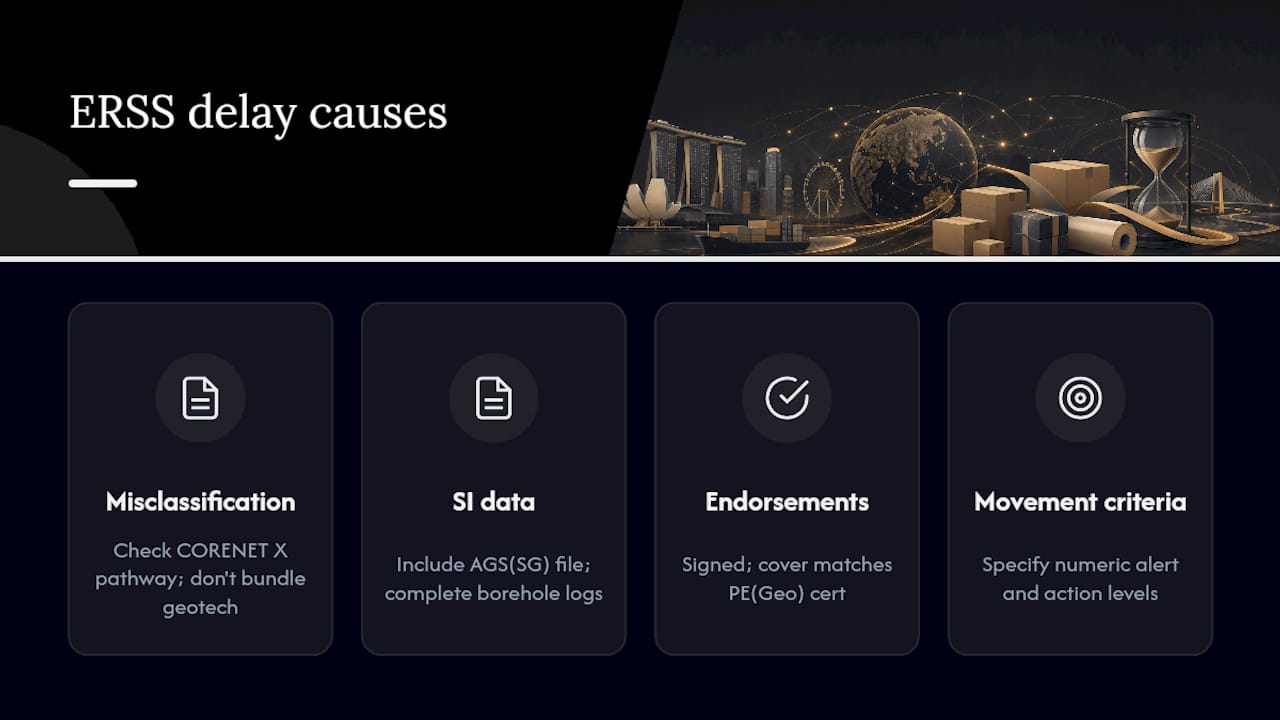
Incomplete or malformatted SI data follows close behind. Submitting a PDF summary without the underlying AGS(SG) data file, or providing borehole logs with gaps in the influence zone, both invite immediate queries. Unsigned endorsements and geotechnical reports whose cover pages don’t match the current practising certificate of the named PE(Geo) fall into the same category of avoidable, purely administrative rejection.
Vague or missing movement criteria consistently rank among the items BCA queries most, according to practitioner experience with the current ERSS submission guidance. A monitoring plan without specific numeric alert and action levels reads as incomplete even if the instrumentation schedule itself is thorough.
Weak stakeholder coordination rounds out the common failure modes. Utility owners, adjacent property owners, and transport agencies often need to be consulted before a submission is finalized, and skipping that step tends to surface as a late request for information that stalls review by weeks rather than days.
What Do ERSS Submissions Typically Cost and How Long Do They Take?
Processing timeframes for ERSS packages vary depending on project complexity and BCA’s current review load, so any quoted fixed duration should be treated as approximate. What holds steady across projects is the shape of the timeline: a complete, correctly classified package with clear movement criteria tends to receive its first substantive review comment faster than a package that arrives with gaps a reviewer has to flag before assessment can even begin.
Consultant fees follow a similarly variable pattern, driven mainly by excavation depth, ground complexity, and adjacency risk rather than by a flat rate card, and firms can enhance project bids by leveraging Construction SEO Services | Prove It & Win More Bids to boost their online visibility. Industry sources indicate PE(Geo) endorsement components on standard projects often fall in the range of a few thousand to the low tens of thousands of Singapore dollars, with complex deep excavation projects running considerably higher once independent checking, extensive SI programs, and instrumented monitoring are factored in. Treat any such figure as indicative rather than a quote, since actual costs depend heavily on site-specific ground conditions.
The main cost drivers worth budgeting for include:
- Site investigation scope: number and depth of boreholes, laboratory testing regime, and whether groundwater monitoring wells are needed
- Independent checking: mandatory for higher-risk GBW and adds a distinct fee line separate from the design team’s own QA
- Instrumentation and monitoring: inclinometers, piezometers, and settlement markers each carry installation and ongoing reading costs, and monitoring frequency during critical construction stages drives recurring expense
- Complexity of the ground model: sites with variable or poorly understood strata often need supplementary SI phases mid-design, which adds both time and cost
A detailed breakdown of these cost components, including how checking fees and testing budgets typically stack against design fees, is covered in our guide to ERSS submission costs in Singapore.
A Practical Pre-Submission Checklist for Qualified Persons
Reducing rework on ERSS submissions comes down to catching gaps before BCA does, and the steps below reflect the checkpoints that most reliably surface problems early.
- Verify every endorsement against the current revision. Confirm the PE(Geo), QP(ST), and independent checker (where applicable) have signed the exact calculation and drawing revision being submitted, not a superseded draft.
- Cross check the geotechnical report against the design calculations. Ground model assumptions, characteristic values, and groundwater levels should match across both documents line for line.
- Confirm AGS(SG) data files accompany every SI-based PDF report and that borehole coverage extends through the full zone of influence, not just the excavation footprint.
- Review the monitoring plan for specific numeric movement criteria, not general statements, with alert and action levels tied to the predicted movement envelope.
- Coordinate with utility owners, adjacent property stakeholders, and the main contractor before finalizing the package, since unresolved third-party concerns are a common source of late-stage requests for information.
- Set up the post-approval monitoring and reporting templates in advance, including who receives instrumentation readings and how alert-level breaches trigger escalation, so the monitoring regime is operational from day one of excavation.
Pro Tip: Build a short internal sign-off sheet that tracks each endorsement, each data file, and each cross-reference between the geotechnical report and structural drawings before the package goes anywhere near CORENET X. A five-minute checklist review at the QP level catches the majority of administrative rejections before they ever reach BCA’s desk.
Coordination with contractors on construction sequencing matters more than it usually gets credit for. A monitoring plan built around a construction program that later shifts by several weeks needs updating before ground is broken, not after an alert level is unexpectedly triggered on a sequence the plan never accounted for.
What We’ve Learned Handling ERSS Submissions in Singapore
Three lessons recur across ERSS projects, and none of them are about design sophistication. The first is that coordination between QP(Geo), QP(ST), and the independent checker needs to start well before the calculation package is finalized, not once drawings are already circulating for signature. Waiting until endorsement time to reconcile ground model assumptions across disciplines is how contradictions surface at the worst possible moment.
The second lesson concerns site investigation quality. A thin SI program almost always resurfaces later, either as a BCA query about characteristic value derivation or as a real design risk once excavation reveals ground conditions the boreholes never captured. Spending more on SI upfront is rarely the expensive choice; it is the cheap one, relative to the cost of a mid-construction design change.
The third lesson is about movement criteria. Numeric, project-specific alert and action levels, tied clearly to the predicted movement envelope, consistently move through review faster than generic monitoring language. Reviewers query vague criteria almost every time.
Aman Engineering Consultancy’s regulatory experience across Singapore’s structural and geotechnical submission landscape informs each of these observations, drawn from ongoing coordination with BCA’s current submission framework and CORENET X’s evolving requirements.
— Aman
How Aman Engineering Consultancy Supports ERSS Submissions
ERSS submissions handled end to end can reduce handoff gaps compared to coordinating separate consultants for design, checking, and platform packaging. That includes PE(Geo) coordination from the earliest scoping stage, arranging independent checking where GBW risk thresholds require it, structuring the SI program before boreholes go in the ground, and setting up monitoring plans with movement criteria specific enough to survive first review.
Engaging early, before the design is locked, is what actually shortens the review cycle. Classification decisions, SI scope, and monitoring strategy all get harder and more expensive to change once a package is already assembled. Our guide on engaging engineering consultants effectively outlines what to prepare before that first conversation, including site boundary details, known ground conditions, and the construction program’s rough sequencing. For projects where the ERSS interacts with permanent works, our temporary works design service covers the full transition from temporary retaining system to permanent structure.
If your project has an excavation depth or adjacency condition that might trigger ERSS obligations, reach out through Amanengineering with your site plan and any existing SI data on hand. That single step lets the team scope the appointment structure and submission pathway before the first drawing is even issued.
Sources
Reviewing the primary documents directly, rather than relying on secondhand summaries, remains the most reliable way to confirm current requirements before a submission.
Always verify current fee schedules and processing details directly through official channels, and treat any communication requesting payment outside gov.sg systems with caution, per ScamShield’s guidance on verifying agency correspondence.